 Australian Labradoodle
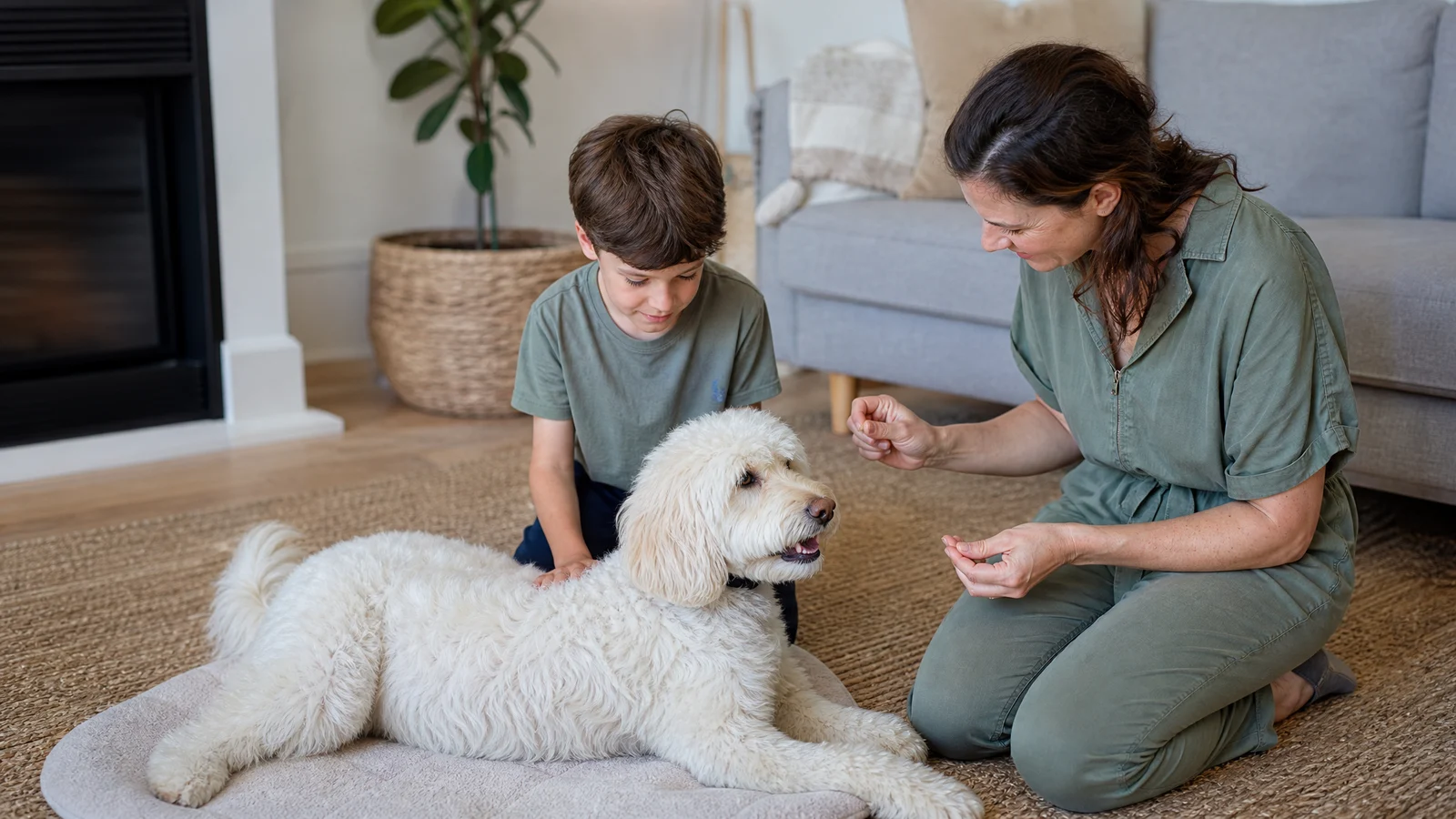
Yes, an Australian Labradoodle can play calmly with young children, but only when adults set the rules. The warmth comes built in, while the calm is a skill that you teach and pay for.
Both parent breeds rate 5 of 5 as good with young children, and the Labrador's playfulness and the Poodle's playfulness also come in at 5 of 5. Put that sociable bounce in a living room and a squeal or a sprinting child reads as an invitation, which is how toppled toddlers and mouthy hands happen even in loving homes.
This guide covers socializing an Australian Labradoodle with children, from the house rules that keep a bouncy dog manageable to rewarded settling, fetch and trade games, toddler floor time and what real supervision looks like. Done well, you get a dog who can stop on cue and children who feel safe beside them.
Australian Labradoodle Socializing Needs Play Rules
A dog who adores children is not automatically a dog who is easy to be around. The Labrador parent is described as exuberant and very energetic, and the Poodle parent as active and very smart, so a cross may bring plenty of bounce along with a quick eye for whatever earns a reaction. We specialize in how this breed behaves and trains, and the pattern holds in home after home: enthusiasm arrives long before restraint does.
You will hear that a gentle, family-loving breed can work out the rules with children on their own. We disagree, because a squeal or a running child looks like an invitation to a dog this playful.
Handled badly, that invitation teaches a dog to treat jumping, mouthing and snatching as the way to join in, and it teaches children to fear a dog who only wanted to play. Handled well, the same devotion becomes a tuned-in companion who checks in with the people around them before charging ahead.
The house rules are simple. An adult stays close during play, children leave food, chews and a resting dog alone, and the dog gets a bed or mat that small hands never invade.
How Do You Pay an Australian Labradoodle for Calm?
Calm has to be paid for before it becomes a habit, and the best moment to pay is before the children join in. A dog who is rewarded for settling learns that quiet is the way into the game, not the end of it. The Poodle parent is rated 5 of 5 for trainability and the Labrador standard calls for an eager-to-please dog, so a cross often picks this up quickly, though dogs vary.
Teach the Mat Without Children First
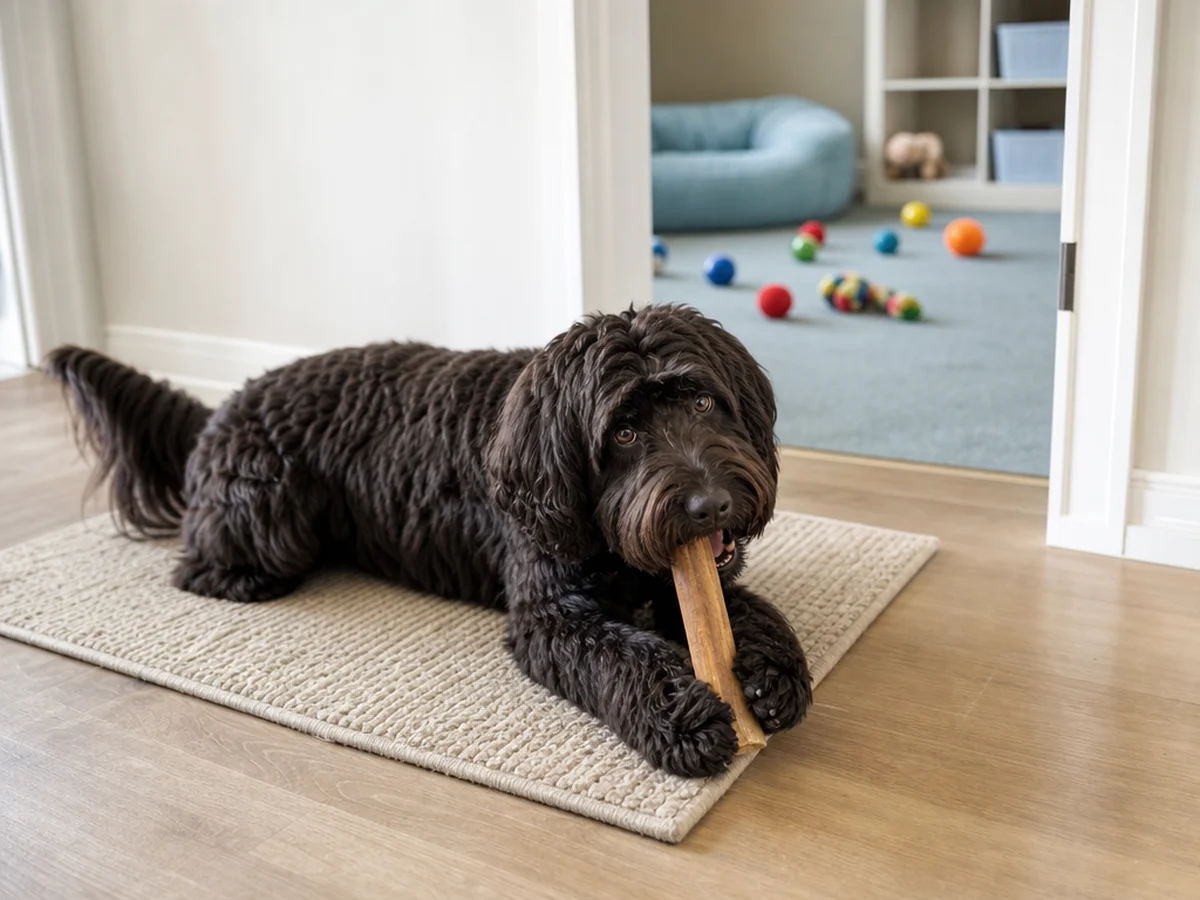
Begin with only adults in a quiet room. When the dog steps or lies down on the mat, mark it with your word and deliver a treat low, right between their paws, then add a few more while they stay. Wait a little longer before each treat as the weeks go on, and release them with a cheerful word so they know when the job is finished.
Next, add a child sitting nearby with a book or a coloring page. Pay the dog for staying put while small movements happen around them.
Let Calm Earn the Game
Once the mat is solid, make the mat the doorway to every play session. Ask for the mat before fetch, before a tug round and before any child leaps off the couch to join in, and let the toy appear only after the dog settles. Play itself becomes the reward, which fits this highly social breed.
Wearing the dog out first has a point, since the Labrador parent scores 5 of 5 for energy. Still, a tired dog is calm from fatigue, while practice teaches a fresh dog to settle.
Which Socializing Rules Can Children Rehearse?
Most training plans fuss over the dog, yet the children can make or break this one. A playful Australian Labradoodle mirrors the energy in the room, so a shrieking, sprinting child gets a bouncing, mouthy partner in return. The good news is that children pick up simple rules fast when you turn them into a game.
Freeze Like a Tree
When the dog gets wiggly or jumps up, the child folds their arms, goes still and looks at the ceiling. A motionless child is a dull target, so the dog soon learns that bouncing earns nothing while four paws on the floor earns attention and a treat from an adult. Rehearse the freeze with a stuffed animal first so it works on the real day.
Children also skip grabbing, chasing and tight hugs. A dog who runs off with a toy gets called over by an adult for a trade, never pursued by a child. If jumping at children is the main trouble, our walkthrough of an Australian Labradoodle four-paws-down hello uses the same reward idea.
Let the Dog Walk Away
Teach children that a dog who turns away, leaves the room or heads for their mat is saying the game is over. The Labrador parent is described as needing to be included in family activities, so a cross may hover near the action and still need a break from it. Pay the dog for choosing the mat, and let the children cheer quietly from where they stand.
Visiting cousins and neighbors need the same rules, because both parent breeds greet everyone as a friend. Give any new child the freeze rule and a seat before the dog says hello.
Australian Labradoodle Fetch Needs a Trade Game
Fetch is the game most children want, and a cross with Labrador Retriever parentage is likely to love it. The trouble is that fetch has a second half, because the toy has to leave the dog's mouth again. Skip that half and children end up chasing a delighted dog around the yard or tugging at a jaw, and both turn into a game of keep-away.
Teach the Trade Before the Throw
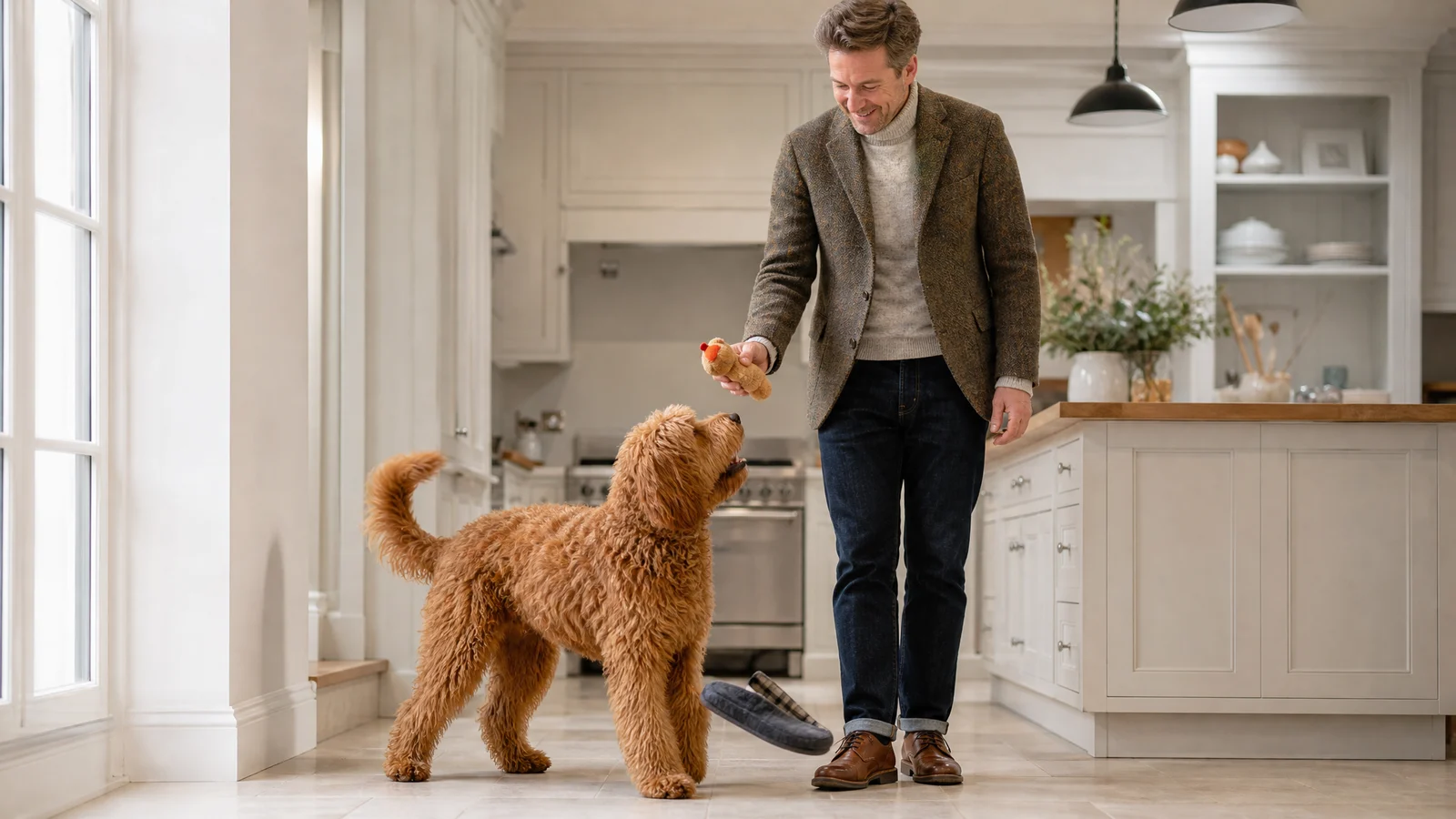
Adults go first, with no children involved. Hold a treat at the dog's nose while they hold a dull toy, say your cue the moment the mouth opens, then reward and give the toy right back. Handing it back is what makes letting go feel safe, because the dog learns that dropping never ends the fun.
Our guide to teaching drop it and trade has the full steps. Start with a low-value toy and save the favorite for later, and keep anything the dog treats like treasure in adult hands.
Letting Children Run Fetch
Once the trade is smooth, a child can throw a soft toy a short way from a marked spot while an adult stands beside them. The child offers the treat for the swap, the toy goes back out, and the game ends before the pace speeds up. Low, gentle throws matter, because a dog launching after a flying toy can crash into small legs.
The Poodle parent is rated 5 of 5 for needing a job or activity, so a clear task like the swap suits a cross. Consistent, fun rounds keep a quick mind busy without winding the dog up.
Toddler Floor Time During Socializing
It can be, with the right setups and an adult on the floor, but it is never something to leave to chance. Even a medium-sized Australian Labradoodle is sturdy and springy, and a wobbly toddler at the height of a bouncing dog's chest is easily bowled over. Add a mouth that loves to carry and taste things, and a hand holding a cracker looks like an invitation.
Why Toddlers Are the Hardest Case
Bites fall most heavily on young children, and the dog most likely to deliver one is their own family's dog rather than a stranger's. A sweet breed reputation does not remove that risk. Setups matter more than reputation, and they matter most at toddler height.
Setups That Keep Toddlers Safe
Use a baby gate or play yard so the toddler has a dog-free zone and the dog has a toddler-free one, and let them meet across it with an adult beside them. When they share the floor, an adult sits within reach and the dog has a chew waiting on their mat.
Keep food out of the picture, since dropped crackers invite snatching, and put away the dog's best chews before the toddler crawls over. A toddler reaching for a treasure is where trouble starts.
Handling Bounce and Mouthiness
Deliver treats low and calmly for four paws on the floor and a closed mouth, and cue the mat whenever the toddler gets noisy or wobbly. When the mouth gets busy, offer a toy to carry instead of hands, then give a short break if it keeps happening. A mouthy dog at floor level is usually asking for play, so redirect with no drama.
If the dog and your toddler have not met yet, our guide to safe introductions covers the first meetings. Take them slowly, with an adult beside the toddler and another handling the dog's leash.
Active Supervision for Socializing Play
Supervision is more than being in the same house. It means an adult is within arm's reach, watching the dog's body and the child's together, and ready to end a round before it gets away from everyone.
Keep sessions short, because children and dogs both lose their judgment once excitement builds. Watch for the early signs, such as a mouth that gets busy, a bounce that gets higher or a child's voice that climbs, and call the break at the first sign rather than the last. If the room keeps dissolving into frantic running, our piece on Australian Labradoodle zoomies and boredom explains the energy behind it.
How much play a dog can take varies with the mix they inherited. The Labrador parent scores 5 of 5 for energy and the Poodle 4, while the Cocker's playfulness is a moderate 3 of 5, so a cross with more spaniel in the mix may wind down sooner than one built more like the other two.
Finish on a calm note rather than with the dog spinning. Hand over a chew on the mat and let everyone cool down, then tell the children they did well.
A second dog changes the picture, since excitement spreads fast. Let walks and play go well before the newcomer comes in, and keep both on leash at the door, because the home is the resident dog's space.
Signs Calm Socializing Play Is Growing
Calm around children is learned through repetition, not controlled by an inborn switch. It builds from small successes repeated until they feel ordinary, and a cross who may bring Labrador exuberance and Poodle brightness needs those repetitions more than most.
Each settle on the mat and each trade that ends with the toy handed back strengthens the habit. So does every game that stops when a child goes still.
You will know it is working when you see these signs. Look for the pattern across several play sessions, not one easy afternoon:
- Your dog heads for their mat on their own when the room gets noisy.
- They pause and look to an adult when a child squeals or runs past, instead of launching into the game.
- They hand over a toy readily and wait for the next throw.
- They walk away from play when they have had enough, and the children let them go.
- Four paws stay on the floor and mouths stay closed when a toddler wobbles near.
Keep regular vet visits in the plan, because pain or discomfort can change how a dog tolerates busy hands. Some signs call for more than practice. If you see growling, guarding of toys, food or favorite spots, a stiff freeze when a child approaches, or frantic mouthing that does not ease when play stops, contact a qualified trainer or behaviorist before anyone is hurt.
Everything else comes back to the same plan: clear rules for the children, rewards for the dog who settles, and an adult close enough to step in. Keep paying for calm, and a dog who loves children so much will learn to show it gently.
 BehaviorTeaching Drop It and Trade to an Australian Labradoodle
 BehaviorTeaching a Mini Australian Labradoodle Polite Dog Play
 Training basicsGentle Training for a Sensitive Australian Labradoodle