 Australian Labradoodle
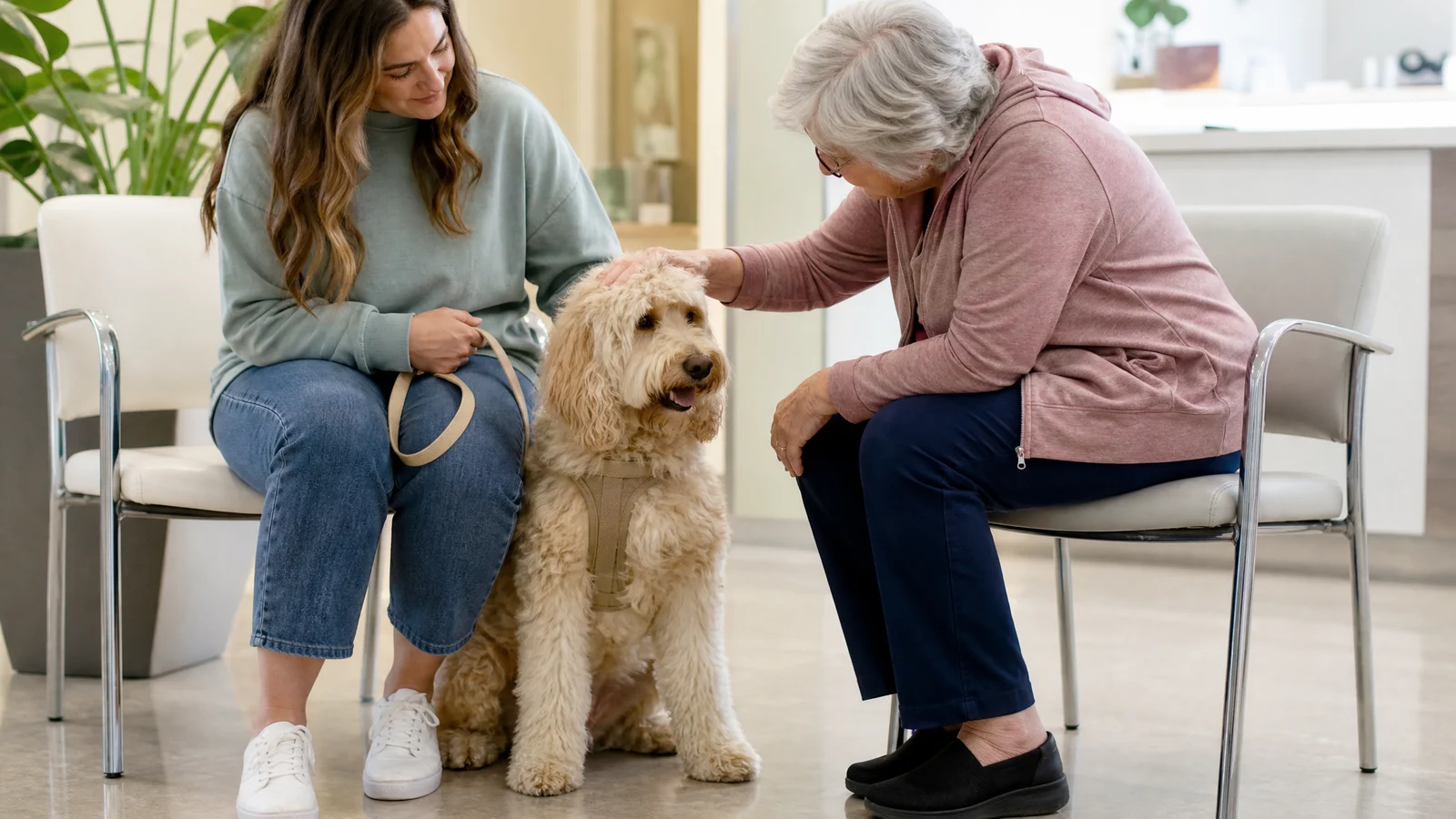
A doodle walks into a clinic waiting room, spots a stranger across the floor, and trots over with tail low and wagging, back end swinging and front paws already lifting toward the person's lap. Owners describe this moment all the time, and it is the whole therapy-dog question in one scene.
What is going on is a friendly temperament that has not yet learned manners. The Labrador and the Poodle both score a full 5 of 5 on breed-profile scales for friendliness toward strangers and for trainability, and a cross may inherit that mix. The cross has no official working record of its own, though, so your dog's individual temperament decides how far this goes.
We'll walk you through the skills that come easily, polite greetings, calm around unfamiliar equipment and slick floors, and session routines that hold up, then the snags owners report and the signs to ask for help. When this goes well, your dog becomes a welcome guest in places most dogs never get to enter.
Therapy Training Basics
Friendliness and trainability give an Australian Labradoodle a real head start for therapy-style work, and the head start is smaller than it looks. Therapy work means visiting people with your dog as your partner. It is a different job from service work, where, according to the AVMA, service animals are dogs trained one by one to carry out particular jobs that assist a person with a disability.
The Lab side has a long record as guide, rescue, service and assistance dogs, and the Poodle side loves people and is eager to please when sessions stay fun. Neither record belongs to the cross. Treat the parents as a reason for optimism and your own dog's behavior as the evidence.
Skills That Come Easily
If your dog already approaches strangers with a loose, wiggly body, you have the hardest piece to teach. Interest in people, willingness to work for praise and food, and quick learning of new cues are what the parent breeds are known for, and a cross may inherit them. Your work then becomes proofing: the same cue near a new face, in a new room, with a new smell.
If your dog instead hangs back from strangers, do not push toward the friendly ideal. The Poodle standard faults shyness, so socialization matters for this cross, but it goes at the dog's pace with food and distance. A reserved dog can be a lovely companion without ever becoming a visiting dog.
Skills That Still Need Work
Handling tolerance is easy to overlook, and it matters a great deal for therapy-style work. Owners who start early get dogs used to machine noise, touch, closed scissors near the eyes and short groomer visits just for a nail trim, and they report dogs who behave well at the groomer. Between visits, weekly baths and combing help prevent mats, and a coat that stays free of tangles makes every handling session more comfortable for your dog.
If your dog dislikes brushing, pair each touch with food. Owners use one treat per stroke, a sticky lick mat, a cue word or a raised surface, and report dogs going from hating brushing to only mildly disliking it. Expect improvement, not a dog who loves it. Match what you see to the fix.
If your dog runs or jumps away, the step is too big, so go back to one stroke and one treat, then stop while they are still comfortable. If they mouth or nip, offer a lick mat or chew during brushing and keep the session short. And if your dog growls at family members or bites, stop the brushing practice and ask a professional for help.
Settling and leash manners need work too, because a friendly dog is usually a pulling dog. Pay your dog for settling on a mat while people talk nearby, and reward a slack leash from the first step, starting where nothing exciting is happening. If your dog settles at home but not in public, move practice outward gradually.
Australian Labradoodle Greetings
Owners describe a dog who is calm in general and then becomes extremely excited when someone comes over or when a person is met on a walk. That pattern tells you the skill is not missing, it is swamped by arousal. If a greeting is polite at low excitement and frantic at high excitement, lower the excitement instead of repeating the cue.
Sitting to Greet
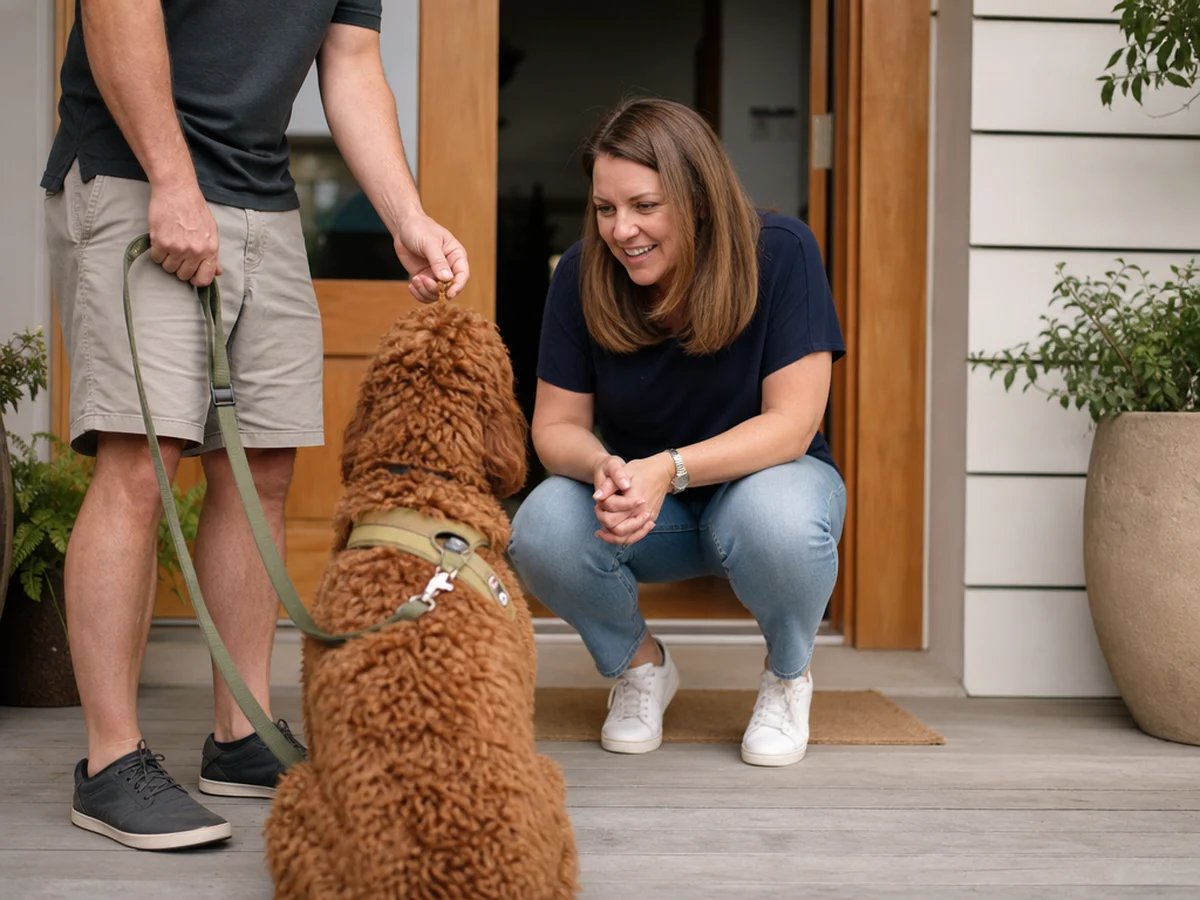
Many owners find that treats at the door produce only a half-sit, with the rear end hovering and the front paws ready to jump. If that is what you see, your dog is too aroused to learn in that moment. Change the setup first: have the visitor wait outside, rehearse with a family member before real guests, and drop the treat on the floor so the head goes down.
Then build the greeting in steps.
Start with the person far away, and reward your dog for looking at them calmly. Step closer only while your dog stays settled, and scatter food on the floor as the reward. Once they are close, ask for a sit when your dog's body is loose, and mark the instant their rear touches down.
Let the person say hello only while all four paws stay down. If paws come up, the person calmly turns away and waits, then tries again.
The rule only holds if everyone in the family follows it every time, because a dog can't be allowed to jump for some people and not others. One visitor who cheers the jumping undoes weeks of work, so tell guests the plan before they ring the bell.
Ignoring Dropped Items
Visiting places have dropped food, small objects and crumbs on the floor, and a dog who dives at everything is hard to take anywhere. Teach a leave-it cue by rewarding your dog for looking away from a low-value item and back at you, paying from your hand. If your dog lunges, make the item smaller or the distance larger before moving on to tempting things.
Equipment Training for Therapy Visits
PetMD cites a trainer who says the tougher challenge is a dog who stays quiet, keeps watching the handler, is accepting of many environments and shrugs off whatever comes up. A friendly dog is not automatically a settled one.
Therapy-style visits put a dog near wheelchairs, walkers, rolling carts, beeping devices and slick floors. If your dog has never met these, expect a startle or a scramble the first time, and plan the introductions at home.
Desensitize in Small Steps
The method is desensitization and counter-conditioning, which works but is not an instant fix and must go at the dog's pace. Start with a walker or chair parked still at a distance where your dog notices it but can still eat. Pair the sight with treats, then move closer over many sessions. If your dog stiffens, stops eating or turns away, you are too close.
Next add movement: a walker nudged forward, a wheel turning slowly, then a person seated in the chair while your dog sits beside you for treats. Management protects this work. Between sessions, keep your dog out of situations that overwhelm them, because a bad scare sets progress back.
Slick Floors and Footing
Slick floors deserve their own practice, because a dog who skates may stop wanting to go forward. If your dog slows or tucks up on smooth tile, lay a path of rugs, walk it with treats at nose height, then remove one rug at a time. If your dog limps or seems sore on any surface, that is a question for your veterinarian.
Training Sessions That Stick
Short sessions, frequent small rewards and the same rules from every person in the house work best. That fits the parents. The Poodle side is quick to please when routines are fun, positive and consistent, and the Lab side is energetic enough that a dog without daily exercise tends toward hyperactive or destructive behavior. A cross may inherit either pattern. Build the routine around what your dog shows you:
- If your dog cannot focus at the start, burn off energy with a walk or play first, then train, because arousal swamps learning.
- If your dog gets silly or mouthy partway through, the session ran too long, so end earlier next time on an easy success.
- If performance drops in a new place, make the task easier there, reward more often and ask for less until the room becomes boring.
- If your dog tires of repetition, vary the order, mix food with play and keep a few new tricks ready, since the Poodle side rates 5 of 5 for needing a job or activity.
Match rewards to the setting. Food works at home, but a visiting dog may need praise, a short game or a life reward like permission to greet, so teach your dog to work for all of them. For more on balancing exercise and mental work, see our piece on Australian Labradoodle brain games and exercise.
Australian Labradoodle Training Problems
These are the snags owners report most, each paired with a fix. Treat each as a diagnosis: find what is driving the behavior, then change the setup before you try to change the dog.
This is general information, so check with your veterinarian before any medicine or diet change.
- Jumping at arrival. Excitement at the door makes sit training only partly effective, so lower arousal with distance, scattered treats and a planned routine, and give the same answer from every person.
- Every dog is a playmate. Some dogs treat every dog they see as a playmate and get wild when told no. Greeting dogs needs the same practice as greeting people, so reward a glance at the other dog and back at you, pass at a distance, and allow greetings only on a loose leash with a calm dog. If play escalates, stop it and wait for calm before it resumes.
- Calm at home, wild with visitors. Before the door opens, send your dog to a settle on a mat and pay for staying there. We cover why dogs bark at the door yet greet visitors like friends in our article on Australian Labradoodle door barking and greetings.
- Resisting handling. Return to one stroke, one treat, and build slowly from there.
Common advice says to let a friendly dog meet every dog and person so they learn manners. For this cross that often teaches the opposite, because every meeting becomes a party they expect. Socialization still matters, so choose quality: calm exposures with a rewarded settle, not constant greeting.
Training Progress and Professional Help
Progress with this breed rarely runs in a straight line. A dog who greets calmly on Monday can be wild on Friday after a bad night or a new visitor, so judge by trends over weeks. Therapy organizations set their own evaluations, so ask yours what they test and use that list as your goal.
- Your dog keeps four paws on the floor within moments of a person approaching, even when excited.
- Your dog recovers quickly from a surprise such as a dropped object or a rolling cart, and looks back to you for a treat.
- Your dog tolerates handling, with only a mild dislike of brushing that does not escalate.
- Your dog notices another dog, looks at you and walks on with a loose leash.
- Your dog settles on a mat in public while people move around.
Some problems need more than a better plan. Call a qualified reward-based trainer, and involve your veterinarian, if you see any of these:
- Fear that does not ease with distance and treats, such as freezing, hiding or refusing food around equipment or people.
- Guarding of food, toys or a person, including growling at family members during handling.
- Persistent frenzy at greetings that does not drop after exercise and weeks of consistent practice.
- Snapping, escalating nipping or biting.
- Sudden behavior changes, which may signal pain and call for a vet visit first.
Regular veterinary visits belong in any plan for a dog who may work with the public, since discomfort often shows up as behavior. Temperament varies, and some Australian Labradoodles will love visiting while others are happier at home, which is a fine result. For all of them the path is the same: patient work in small, rewarded steps that turn a friendly, eager dog's enthusiasm into calm.
 BehaviorWhy Does My Australian Labradoodle Bark at the Door?
 Training basicsCrate Training a Velcro Australian Labradoodle Puppy
 Exercise and jobsAustralian Labradoodle Energy Level: Apartment Brain Games