 Australian Labradoodle
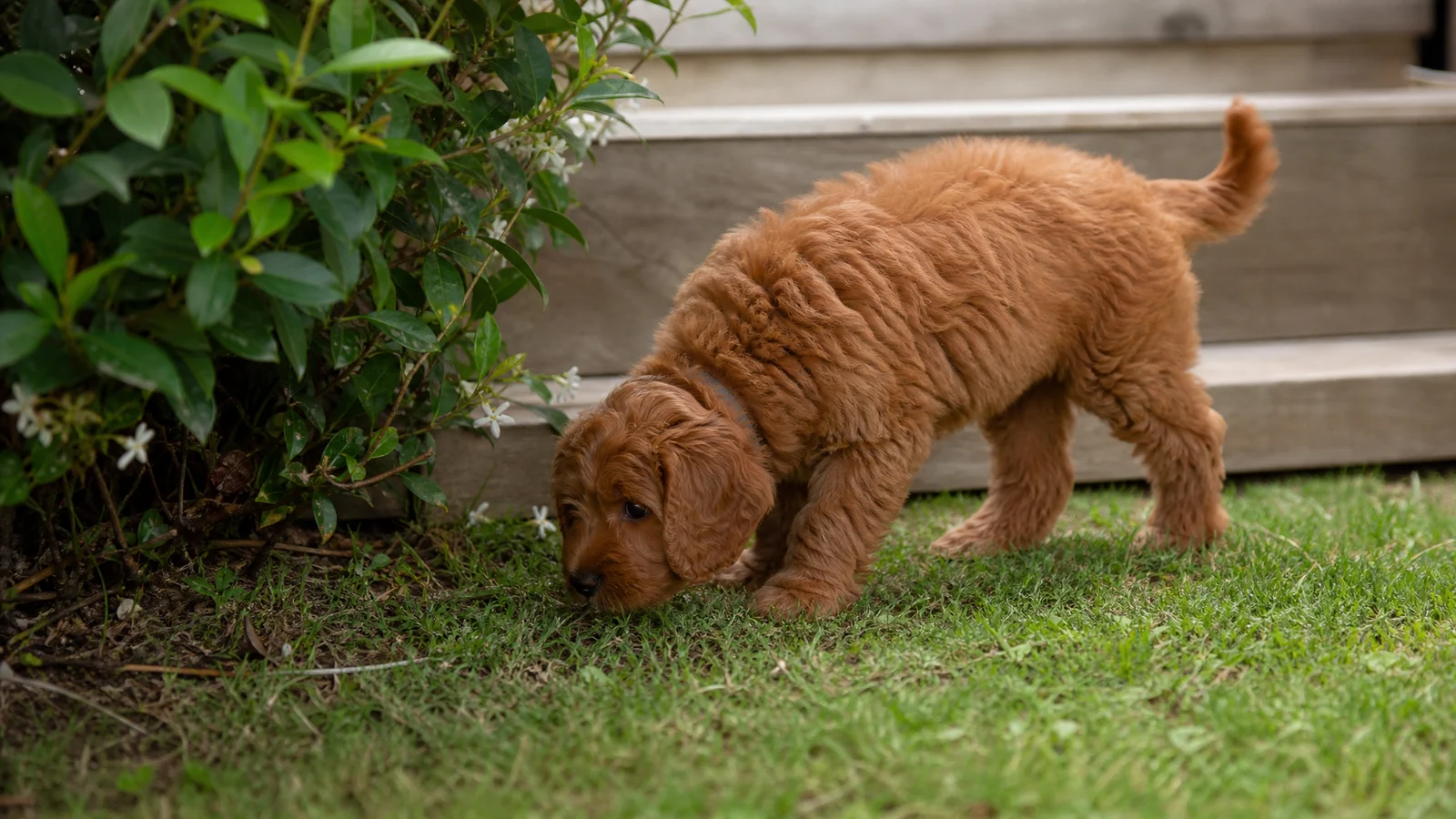
How often should an Australian Labradoodle puppy go outside? The honest answer is not a clock rule unsupported by the available evidence. It is a repeatable sequence built around waking, eating, play, rest, and close supervision, with a reward delivered immediately after the puppy finishes outdoors.
To make that sequence concrete, we will follow one clearly hypothetical puppy through an ordinary family day. This is a teaching example, not based on an actual dog or client, and it does not promise that every puppy follows the same pace. The details show decisions you can adjust around your own household.
Below, you'll find a worked potty training day from the first trip outside through bedtime, including a schedule map, distracted outdoor trips, accident cleanup, and signs of progress. The example also accounts for a fluffy coat, playful attention, and the people-focused temperament this cross may inherit.
A Hypothetical Potty Training Day
Our example begins with a family who keeps the puppy nearby whenever they are awake. The puppy has one outdoor potty place, a lightweight leash ready by the door, and small rewards already in a pocket. The family is teaching a route and a sequence, not waiting for the puppy to invent a signal.
An Australian Labradoodle may inherit strong adaptability and trainability from the parent breeds, but those traits do not create bladder control or household knowledge. The likely advantage is that a consistent route can become familiar quickly. The risk is that play, people, smells, and movement make the outdoor job easy to forget.
The table maps the hypothetical day by events rather than unsupported time intervals. Each row begins with something the family can observe, which makes the plan usable even when meals, naps, and work schedules shift.
| Event | Family action | Lesson for the puppy |
|---|---|---|
| Waking | Go directly to the same outdoor spot | Waking predicts the potty route |
| Food or water | Supervise closely and prepare the next trip | Household events lead to a familiar routine |
| Active play | Pause before attention scatters | Excitement does not cancel the routine |
| Rest | Go outside promptly after the puppy rises | Leaving the bed predicts an outdoor chance |
Morning Australian Labradoodle Potty Training
Morning gives the family several natural repetitions without turning the day into a drill. The puppy wakes, eats, plays, and rests, so the same route can follow different events. Repetition teaches the pattern, while a calm leash and quiet outdoor spot keep the puppy's social energy from taking over.
The First Outdoor Trip
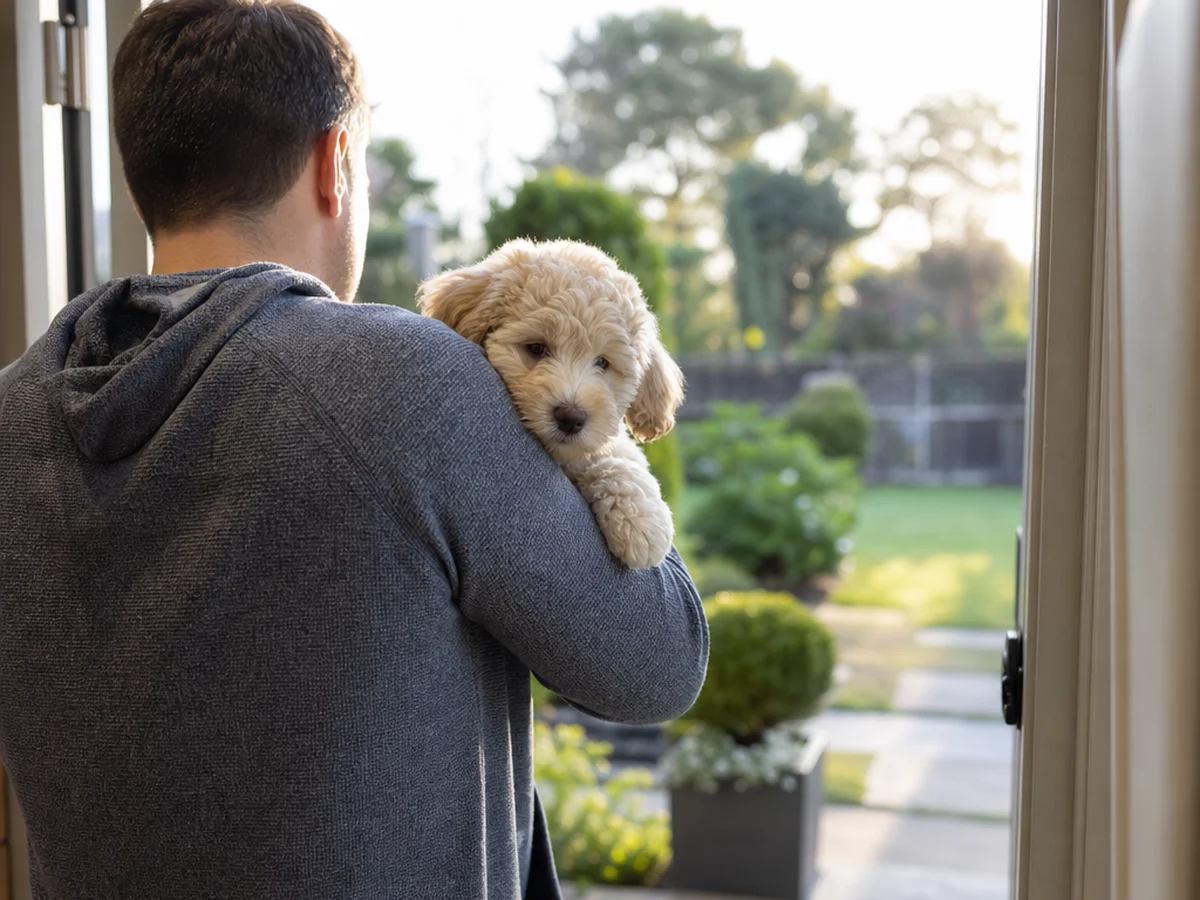
The hypothetical puppy wakes near the family and is carried or guided directly outside, depending on the home's layout. Nobody starts a game or wanders through the kitchen first. The family uses the same door and heads to the same patch, reducing the number of decisions the puppy has to make.
Outside, the handler becomes boring. The leash provides enough room to sniff the chosen area, but it does not begin a tour of the yard. When the puppy finishes, the handler marks that moment and delivers the reward at once. Reward-based training makes the completed behavior more likely to recur.
Breakfast and Supervision
After breakfast, the puppy stays in the same room as an attentive adult. Close supervision means watching behavior, not merely sharing the room while reading a screen. Sudden sniffing, circling, leaving play, or moving toward an edge of the room earns a calm trip outside before an accident develops.
The fluffy coat adds a small practical job. Keep long hair around the rear clean and out of the way, and check it after the trip so discomfort does not make the routine unpleasant. Grooming is separate from toileting, but a quick visual check prevents a coat problem from becoming part of the puppy's outdoor hesitation.
Play Before the Next Rest
Play raises arousal, which can hide earlier signals. The puppy may chase a toy, mouth a sleeve, or bounce toward a person instead of pausing to sniff. In the worked example, the family ends active play while the puppy can still think, takes the familiar route outside, and rewards completion before offering more freedom.
If nothing happens, the trip stays uneventful. The family returns indoors for close supervision and tries again after the next observable change rather than turning the yard into endless entertainment. Potty first and play afterward creates a useful contrast: finishing outdoors opens access to the fun part of being outside.
Midday Australian Labradoodle Potty Training
Midday tests whether the routine survives ordinary household motion. A person takes a call, lunch is prepared, and the puppy shifts between activity and rest. The family protects the learning by choosing either active supervision or a comfortable managed space, never vague freedom that nobody is actually watching.
Rest, Waking and the Route Outside
In this hypothetical day, the puppy naps near the family. As soon as the puppy wakes and stands, an adult takes the same route outside. The quick transition matters because it connects a visible event with the new habit. Delaying until after chores makes success depend on control the puppy may not have yet.
A crate can support the routine only after it has been taught as a comfortable resting place. It is not a shortcut for long absences, and it should allow the puppy to settle without using one end as a toilet area. Our Australian Labradoodle crate training plan explains how rest and gradual separation fit together.
When the puppy finishes outside, the family marks and rewards, then offers a little supervised freedom. That order makes outdoor toileting the key that opens the room rather than an interruption that ends something enjoyable. The puppy is learning where to go and what successful completion makes possible.
Household Motion and Outdoor Distraction
The next trip happens while a neighbor, person, or dog is moving nearby. A friendly, playful puppy may forget the original job and pull, whine, or stare. Best Friends notes that leash reactions can include pulling and whining around people, animals, bikes, or cars, although the cause varies by dog.
The family responds by adding distance rather than repeating the potty cue into rising excitement. They return to the familiar patch when the puppy can sniff and take food calmly. If the distraction remains too strong, they go indoors under close supervision and try after the scene has passed.
This is where the breed's possible eagerness cuts both ways. A puppy who learns fast may also learn that outdoor trips predict greetings. The family therefore keeps most potty outings socially quiet and saves greetings for separate moments, so seeing a person does not automatically replace the task.
Evening Potty Training and Accidents
Evening brings fatigue, family activity, and the puppy's playful energy into the same room. Signals are easier to miss, and an accident is more likely to feel like a setback. In the worked example, the family treats it as information about supervision and timing, then restores the routine without changing the emotional tone.
A Distracted Trip That Produces Nothing
The puppy goes outside after play and becomes absorbed in leaves moving across the ground. The handler waits quietly in the familiar area, but the puppy never settles enough to finish. The family returns indoors without play and keeps the puppy close, because free roaming after an unfinished trip creates the hardest accident to prevent.
On the next attempt, the handler chooses a quieter route and pays promptly after success. The reward is calm and immediate rather than a party that sends arousal back up. The puppy then gets a brief chance to sniff or play, making the sequence clear without turning the toilet area into a place where nothing enjoyable happens.
The principle is the same one used throughout Australian Labradoodle training: lower the difficulty until the correct behavior can occur, then reward it. The family is not testing whether the puppy knows better. They are arranging the next repetition so the desired choice is easier.
An Indoor Accident Without Drama
Later, the puppy slips behind a chair and urinates before anyone notices. The family does not treat the accident as proof of defiance. They calmly move the puppy away, clean the area thoroughly, and identify the missed transition: active play had ended, but nobody took responsibility for the next outdoor trip.
A useful accident review stays practical and looks forward rather than assigning blame. Work through the same questions while the setting is fresh, then change one part of tomorrow's routine:
- Identify the event immediately before the accident, such as waking, food, play, or a gap in supervision.
- Decide who will watch the puppy during the same household period tomorrow, rather than assuming everyone is watching.
- Block access to the hidden spot while the outdoor habit is still developing.
- Prepare the leash and rewards before the next likely transition so the trip is easy to start.
- Return to the familiar outdoor place and reward the next success promptly, without trying to balance the earlier mistake.
Reward-focused practice protects learning and the relationship. The American Veterinary Society of Animal Behavior recommends reward-based methods for dog training. A PLOS ONE study of companion dogs also found more stress behaviors in schools using mostly non-reward methods than in reward-based schools.
Reading Potty Training Progress
By bedtime in this hypothetical day, success is not a perfectly clean house. Progress is a puppy who follows the familiar route, begins to finish more readily in the chosen place, and returns to the family after the reward. The adults are also improving because they are noticing transitions and assigning supervision clearly.
Over the following days, look for a longer chain of correct choices rather than a dramatic overnight change. The puppy may begin moving toward the usual door, pausing play before elimination, or settling faster in the outdoor spot. Keep rewarding the completed behavior while those early signals become dependable.
Setbacks still provide useful information. An accident after an exciting visitor suggests the environment was too difficult, while repeated accidents after waking point to a missed routine. If accidents become sudden, unusually frequent, or paired with a change in the puppy's comfort or behavior, speak with your veterinarian and keep regular veterinary checkups.
The worked example ends where real training continues: one observable event, one familiar route, one quiet chance to finish, and one prompt reward. An Australian Labradoodle puppy may learn that sequence quickly, but reliability grows from management and repetition. Make tomorrow's ordinary day easier to read than today's.
 Training basicsAustralian Labradoodle Training: A Reward-Based Plan
 Training basicsLoose-Leash Walking for an Australian Labradoodle Who Pulls
 BehaviorSafe Introductions for an Australian Labradoodle Family Dog