 Australian Labradoodle
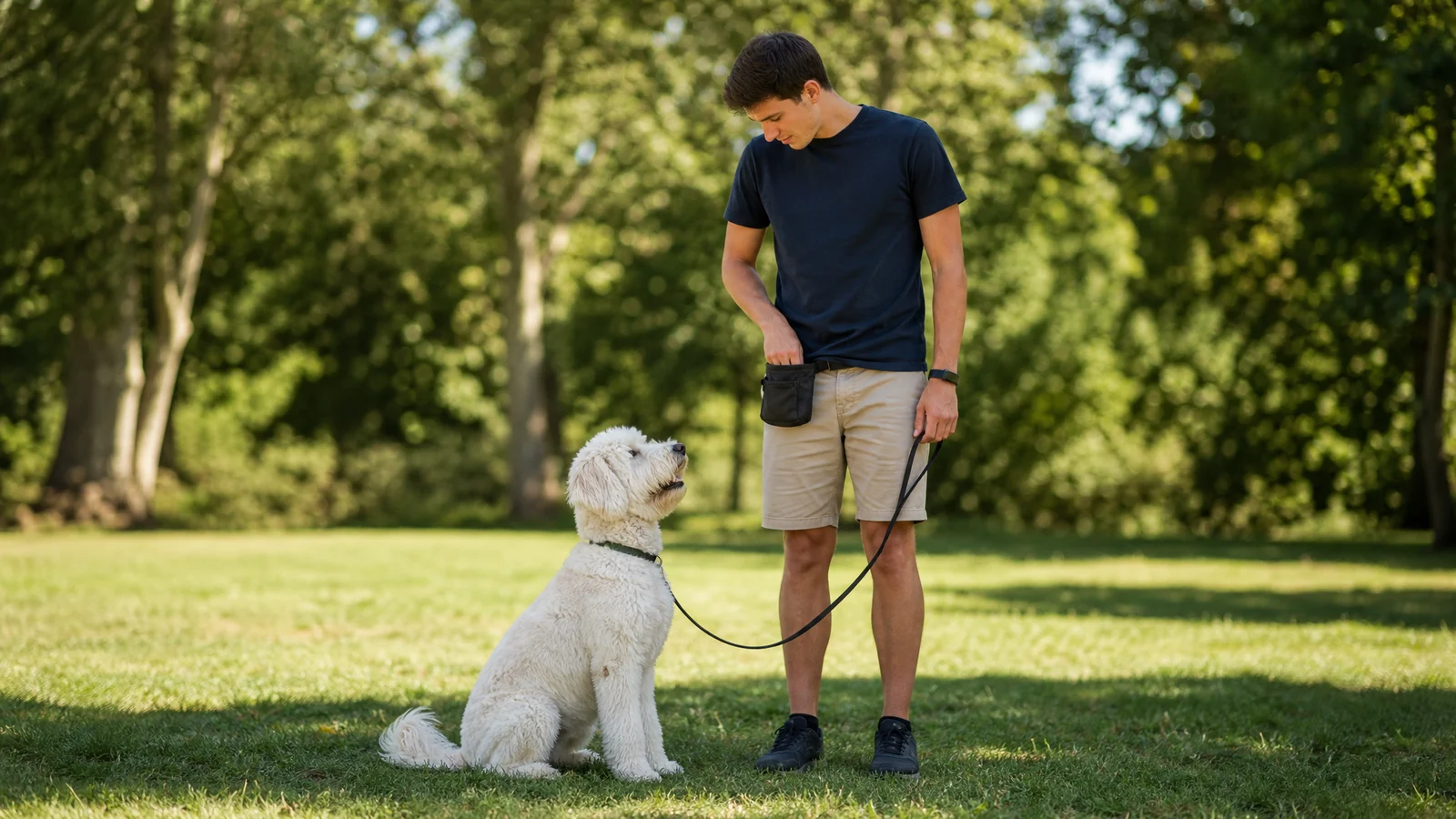
Australian Labradoodle training works best as a system, not a race through commands. This cross may inherit Poodle intelligence, Labrador willingness, Cocker sensitivity, high energy, and strong interest in people. Those qualities can produce a quick learner whose attention still disappears when life becomes exciting. A coherent system keeps speed from being mistaken for reliability.
Seven principles keep that possibility useful. Each principle answers a practical question: what to reward, how long to work, when to add excitement, why cues fail in new places, how to meet mental needs, what the household must agree on, and which results matter. Together they turn separate exercises into a routine the dog can understand.
We'll walk you through the principles in the order they support one another, then show how to judge progress in ordinary family life. The goal is not a dog who performs endlessly. It is an Australian Labradoodle who understands the household, can settle, and can make useful choices around real distractions. That standard keeps the guide focused on household function instead of performance for its own sake.
Australian Labradoodle Rewards Shape Training
A reward tells the dog which behavior is worth repeating. The American Veterinary Society of Animal Behavior recommends reward-based methods for dog training, including behavior problems. Structure still matters, because the dog needs a clear opportunity to act and a clear result after the choice. Rewards work best when access, timing, and criteria remain predictable.
Begin with a marker, which is a brief sound or word that identifies the exact successful moment. Battersea advises pairing a clicker with food and delivering the treat within 3 seconds during the early association. A spoken marker can fill the same timing job when it is used consistently. Choose one sound, practice it away from distractions, and preserve its meaning.
Reward placement adds another layer of information. Food delivered low between the paws supports a settle, while food delivered beside your leg supports a walking position. Praise and play can follow too, but the first payment should help the dog remain in the picture you want instead of pulling them out of it. Careful placement makes the next correct choice easier and reduces unnecessary repositioning.
Brief Australian Labradoodle Training
Brief sessions protect accuracy. Poodles are described as extremely intelligent and easily trained, while Labrador puppies are high-spirited, active, and willing. A cross may learn a new pattern quickly, then become silly or restless when repetition continues after the useful learning has already happened. Ending earlier protects clarity and leaves some enthusiasm for the next return.
Stop while your dog is still engaged and the response is clean. A short pause for sniffing, movement, or rest lets arousal fall before another lesson begins. Several successful returns to the work are more informative than one long stretch that ends with grabbing, wandering, or frustrated guessing. Those returns also reveal whether the dog can recover between activities.
Session length should follow behavior rather than a timer unsupported by the material. Soft treat taking, quick reorientation, and relaxed movement say the lesson can continue. Slower responses or frantic offers say the next repetition should be easier, or that the session has already accomplished enough. Read the quality of the response, not human determination to finish a preset block of practice.
Calm Training Before Excitement
Calm is a trained behavior, not the absence of personality. It gives energetic choices a reliable off switch. Labrador Retrievers and Poodles each rate 5 of 5 for playfulness, and the Labrador rates 5 of 5 for energy. An Australian Labradoodle may bring that spark into greetings, leash walks, games, and any room where people are moving.
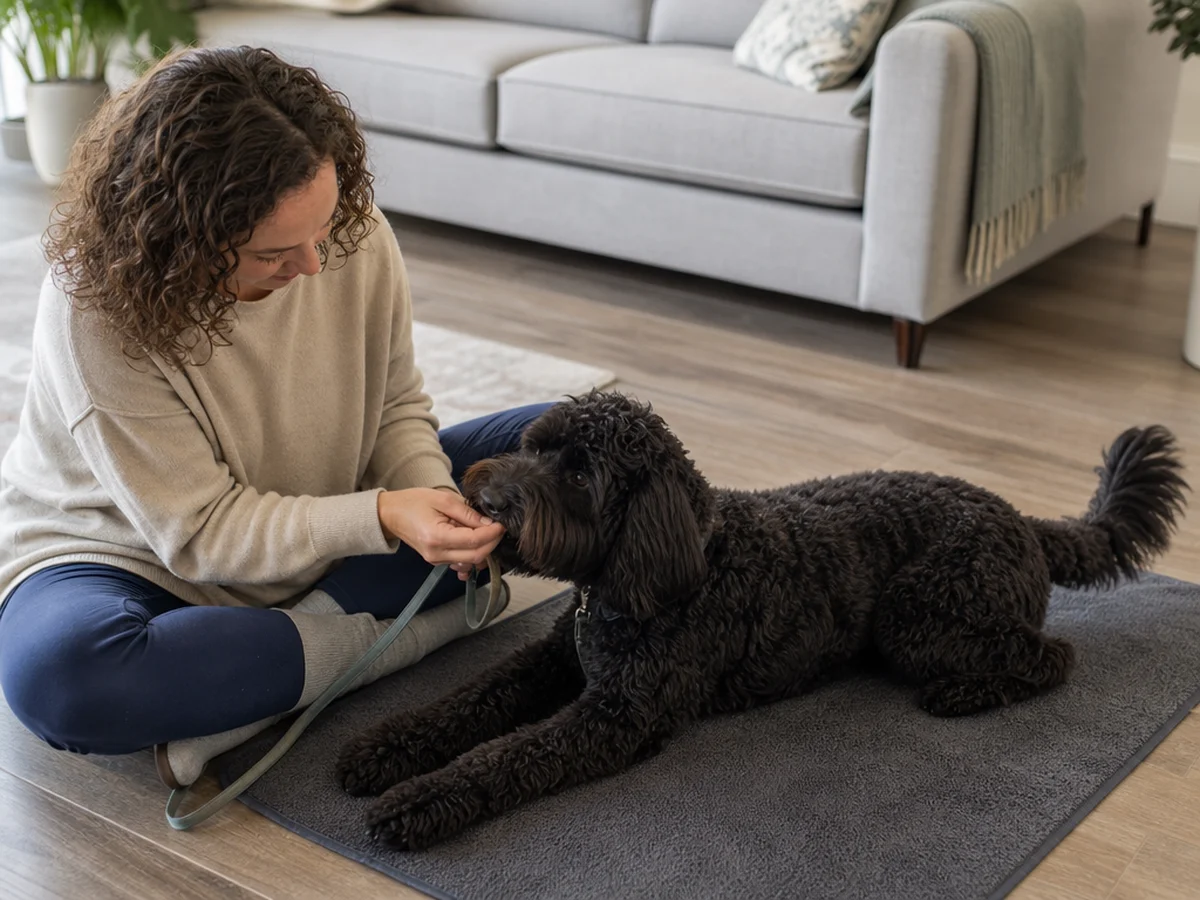
Teach a settle where the environment is quiet. Mark a voluntary pause, a shift of weight onto a mat, or a choice to lie down, and place the reward low. Build duration gradually while you remain nearby. Release before the dog gets up, so waiting stays understandable. The dog learns that stillness produces results just as reliably as active cues do.
Add excitement in layers after the calm behavior is familiar. A family member can move across the room, a toy can appear at a distance, or a door can open partway. If the dog leaves the settle, reduce the change and reward an easier success. Successful recovery matters more than holding too long. Our Australian Labradoodle temperament guide explains why eagerness and overarousal need separate readings.
- Teach the calm response in a quiet room before asking for it near visitors or outdoor movement.
- Change one feature at a time, such as distance, motion, or the value of the distraction.
- Reward recovery after excitement, not only the first calm response before anything happens.
- Return to an easier layer when the dog cannot eat softly, pause, or reconnect with you.
Training Cues in Context
A cue is tied to the picture in which it was learned. A kitchen sit and a sidewalk sit may feel like different problems to a dog, even when the human word is identical. Generalization is the process of rebuilding the behavior across rooms, people, surfaces, distances, and levels of activity. Each version teaches the dog which details matter and which can change. That distinction is what eventually makes the cue portable.
Start each new context with easier criteria. Stand closer, reward sooner, and ask for a response the dog already knows well. Once the behavior is fluent there, change one detail. This approach prevents the common error of treating a weak response in a busy place as disobedience. It also gives the handler a clear way to adjust difficulty. Easier context is a teaching tool, not retreat.
Friendly dogs need special care around greetings because access to a person or dog can become a powerful reward. Use distance until your dog can look and return attention, then decide whether a greeting fits the lesson. Social access becomes deliberate payment rather than an automatic outcome. That change reduces pulling without making friendly interest a problem. The Australian Labradoodle leash training plan applies this principle to forward movement and social access.
Meet the Mind Before Training Repetition
Mental work is part of training for a cross who may inherit the Poodle's 5 of 5 mental stimulation need and the Labrador's 4 of 5 rating. More repetitions of the same cue are not always the answer. Variety, problem solving, and sniffing can restore thoughtful engagement when drilling creates flatness or frenzy. The useful question is which activity improves focus after it ends. Judge enrichment by the behavior that follows, not its novelty.
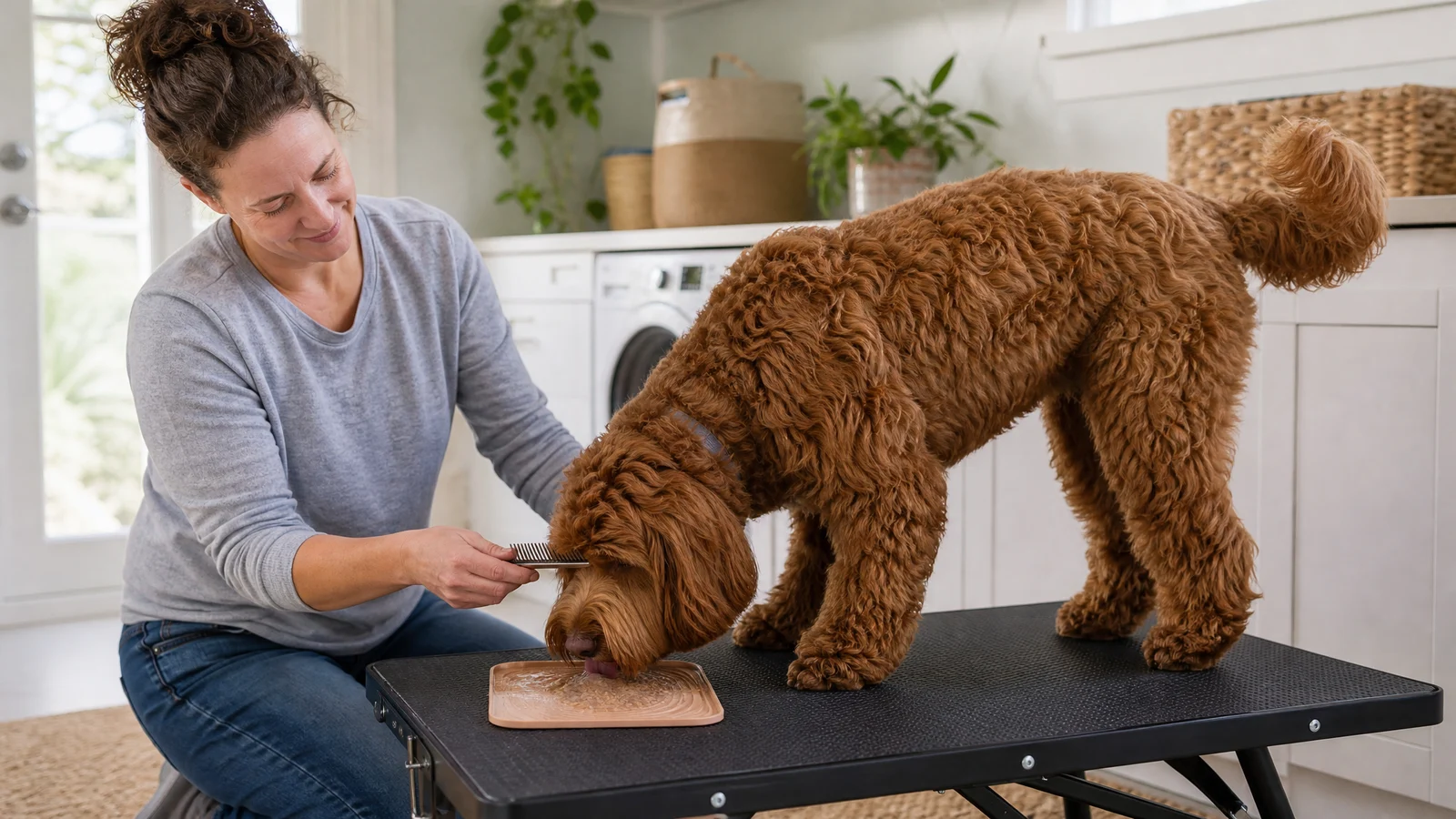
The ASPCA notes that meals can provide enrichment and that food puzzles can slow eating while adding mental stimulation. Use part of an ordinary meal in a simple search or puzzle when appropriate for your dog. Supervise the first attempts and match the difficulty to current skill. Easy wins teach persistence before harder puzzles appear. Keep the first version easy enough to solve without frustration.
Enrichment should support the household skill you are teaching. A scent search can precede a settle, a toy carry can lead into a release cue, and a food puzzle can occupy a resting place. The activity is not filler between training sessions. It gives the dog's brain an acceptable job and makes recovery practice possible. A good activity leaves the dog ready to settle or reconnect rather than more frantic. Rotate options before frustration becomes the main lesson.
Share One Australian Labradoodle Training Rulebook
Consistency means the same cue predicts the same opportunity and result across people. It does not require every family member to sound identical. A people-focused dog notices small differences quickly, so the household should agree on the behavior itself, the marker, the release, and what happens after success. Agreement gives the dog one stable route through familiar household moments.
Write the rulebook around daily pressure points rather than a long command inventory. Doorways, meals, play, rest, grooming, and walks are repeated naturally, which makes them strong teaching moments. Repeated routines also expose small inconsistencies faster than occasional formal practice. The family should also decide who supervises a puppy during transitions, since shared responsibility can easily become nobody watching.
A compact household agreement keeps daily decisions visible and prevents family members from improvising incompatible rules. Put the following points where everyone can check them before busy moments. The list is short enough to use, but specific enough to settle common disagreements:
- Use one word for each cue and one separate word that releases the dog from the behavior.
- Mark the same visible action, so partial and complete responses do not earn randomly.
- Place rewards where the dog should remain, especially for settling and leash position.
- Pause access to play or greetings until the behavior required for access is available.
- Record which context is difficult, then rehearse an easier version before trying it again.
Review the agreement when progress stalls. A household that pays for jumping in one moment and requests four paws down in another creates two profitable options. The dog is responding to both histories. Simplify the rule and make the next household repetition predictable before raising the challenge.
Measure Training by Everyday Choices
Training is working when the dog begins to offer useful choices before a cue arrives. Look for a pause at the door, a glance back from a distraction, a voluntary settle near the family, or a loose step on the leash. These behaviors show that the system is becoming part of daily life.
A PLOS ONE study involving 92 companion dogs found more stress behaviors in schools using mostly non-reward methods than in reward-based schools. Your own useful measure is a dog who remains willing to engage, recovers from mistakes, and can succeed without rising tension.
Keep regular veterinary checkups in the plan, and speak with your veterinarian if willingness, tolerance, movement, or behavior changes suddenly. A reward-based trainer can help when fear, persistent overarousal, or aggression prevents safe practice. Good help lowers difficulty and protects everyone while new skills develop.
The seven principles work as one chain. Reward clear choices, keep the work brief, teach calm, rebuild cues in context, meet mental needs, align the household, and measure ordinary behavior. For an Australian Labradoodle, that system turns intelligence and social energy into dependable cooperation without trying to erase the breed's enthusiasm.
 Training basicsLoose-Leash Walking for an Australian Labradoodle Who Pulls
 BehaviorSafe Introductions for an Australian Labradoodle Family Dog
 CareHow to Groom an Australian Labradoodle Who Wiggles