 Australian Labradoodle
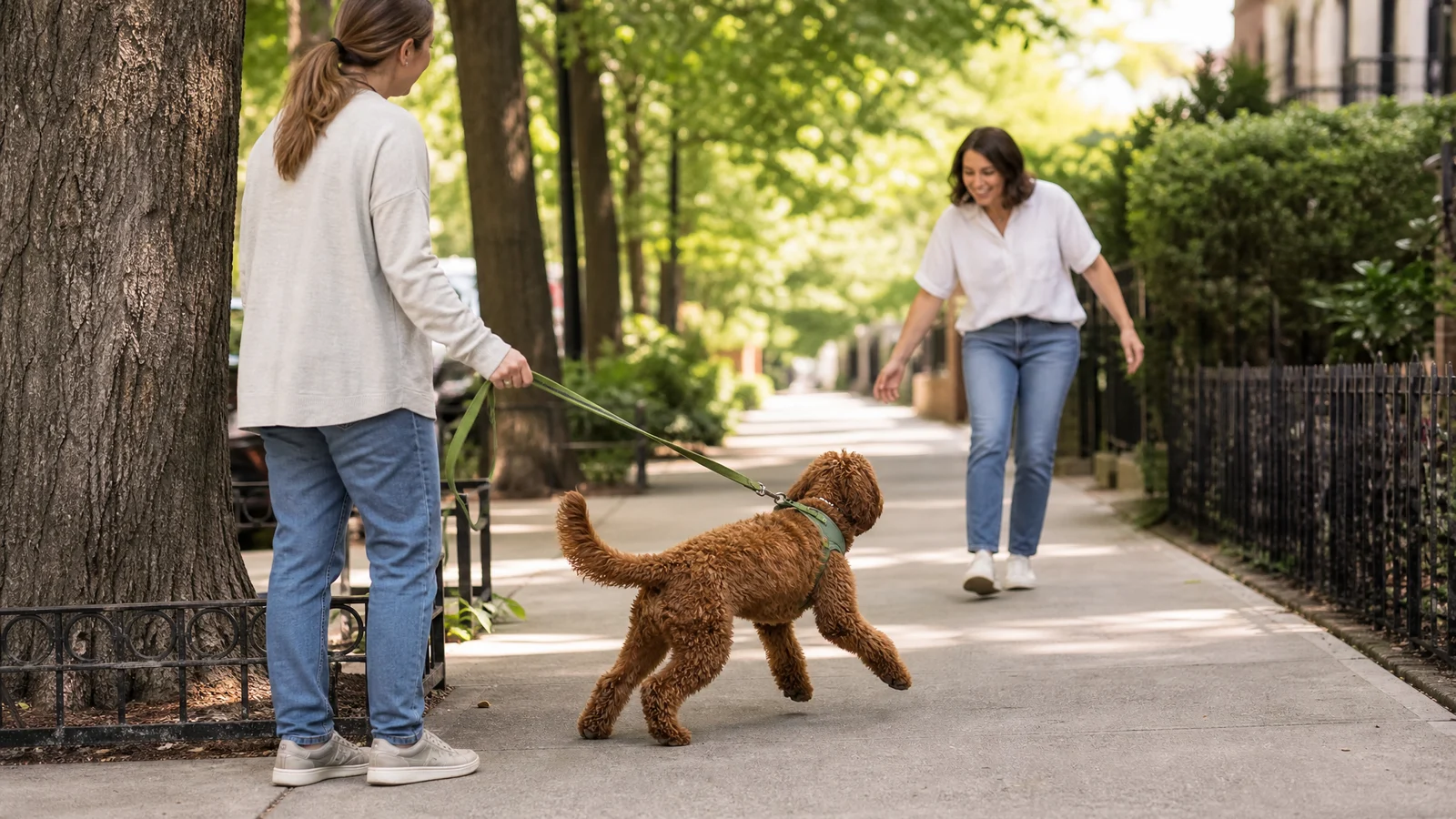
Loose-leash walking improves when tension stops producing forward motion and slack begins to pay. For an Australian Labradoodle who pulls toward people or dogs, the first job is not covering more sidewalk. It is teaching that staying connected to you is the route to movement and, sometimes, a greeting.
The breed-specific possibility is friendly intensity. Labrador Retrievers and Poodles each rate 5 of 5 for openness to strangers, while Labrador Retrievers and Cocker Spaniels both receive the top parent-breed rating for dog sociability. A cross may inherit that sociability, but individual body language still decides what the pulling means.
Read on for the mechanism behind greeting lunges, the reward position that organizes your walk, slack-leash practice, calmer exits, and proofing around motion. We will start where your dog can think, then add the people, dogs, and moving sights that make the real walk difficult.
Why Australian Labradoodles Pull to Greet
Pulling persists because it often works. The dog leans forward, the person keeps walking, and the sidewalk moves beneath them. If the dog reaches a new friend, tension has purchased the most valuable outcome in the scene. Changing the behavior starts by changing that consequence, not by competing with it after the dog arrives. The environment must make slack productive before tension succeeds.
Friendly Greeting Drive
A loose, wiggly dog who pulls toward a person may be seeking social contact rather than conflict. The parent-breed ratings make friendly interest plausible, but they cannot interpret one dog from a distance. Look at the whole body, the ability to take food, and whether the dog can turn away with added space. Those details tell you more than the destination of the pull alone.
Greetings should become occasional rewards rather than promises. If every person or dog means access, spotting one starts the pulling sequence before you can respond. Many walks should include calm observation and passing by. When a greeting does happen, slack and four paws down open the final approach. Access then confirms the behavior that carried the dog there.
Movement Raises the Stakes
Motion can make a social target harder to leave. A jogger, rolling cart, playing child, or dog crossing the street changes position quickly, and the leash restricts the Australian Labradoodle's ability to investigate. Frustration may appear as bouncing, whining, barking, or lunging even when the original interest was friendly.
Distance is the first useful adjustment. Move far enough away that your dog can notice the motion and still eat softly or look back. If the body stays rigid, vocal behavior rises, or food no longer matters, increase space again. The training zone begins where thought is still available. Begin farther away than necessary and close space after success.
Building a Leash Training Reward Position
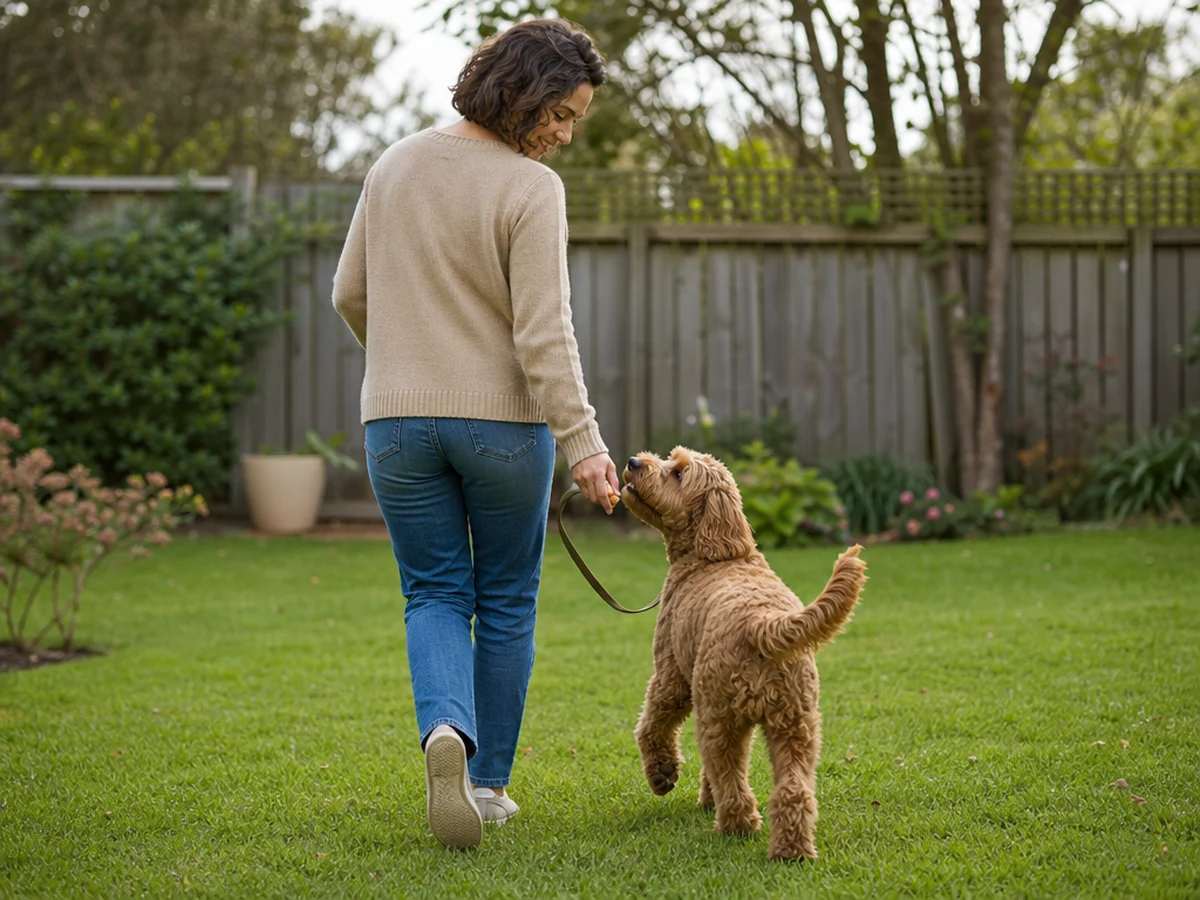
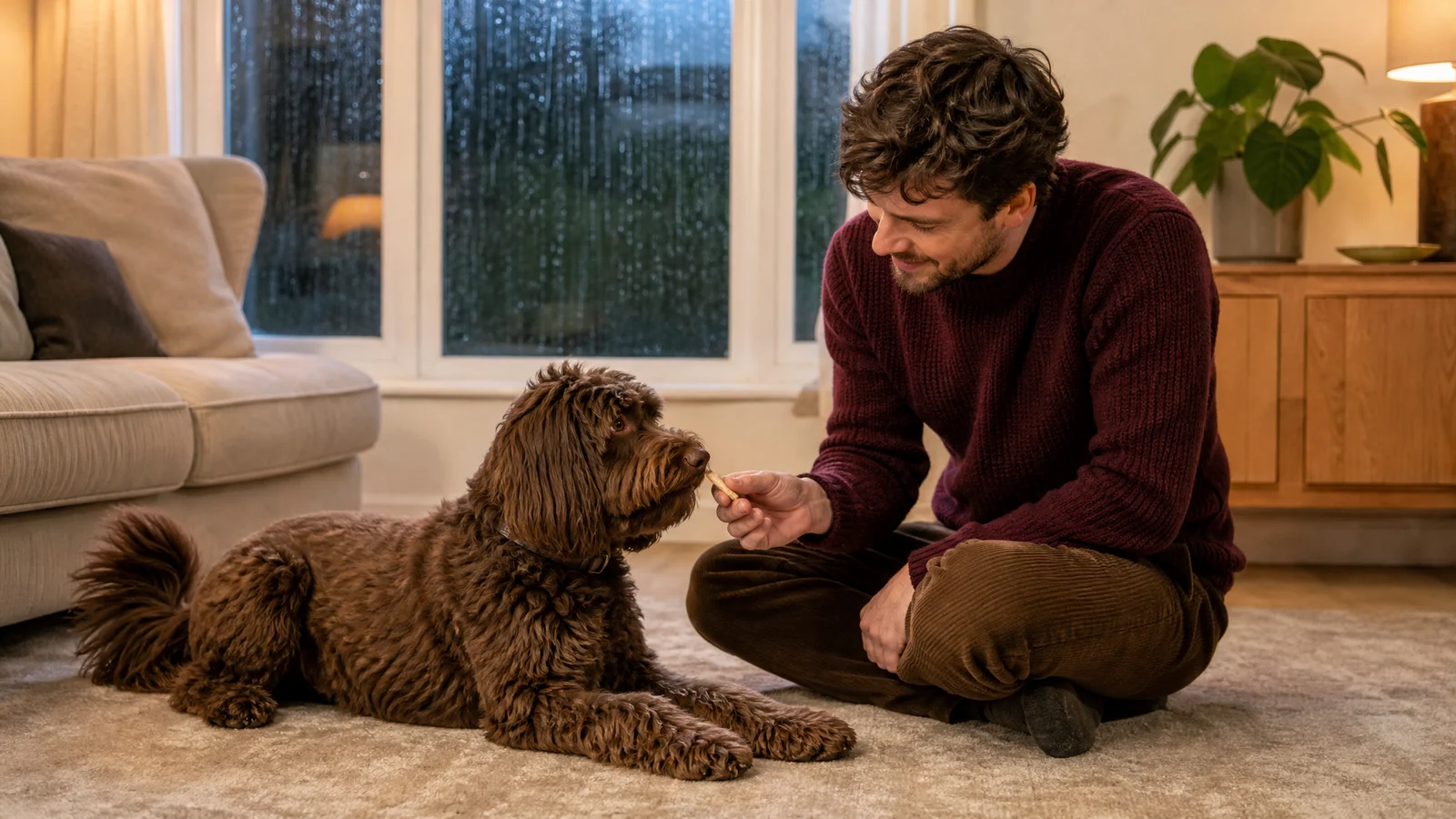
A reward position is the place near your body where good things arrive during the walk. It is not a rigid performance posture. For daily leash training, choose a comfortable side, keep the leash in a relaxed curve, and pay where the dog's shoulder naturally lines up near your leg. A consistent delivery point makes that area easy to rediscover.
Marker and Reward Placement
Begin indoors or in a quiet yard. Stand still, mark when your dog enters the chosen area, and deliver food beside your leg. Take one easy step and pay again if the dog remains nearby. The repeated placement makes the position easy to find without pulling the dog into it.
Use small, easy-to-eat rewards so the dog can swallow and continue. Praise can follow, while permission to sniff can become a larger payment after several connected steps. The position should lead to useful life outcomes, not trap a friendly, curious dog beside you for the entire outing. Choice and exploration keep the position worth returning to.
Resets Without a Struggle
When the dog moves ahead, stop your own forward progress and wait for slack or a turn back. PDSA advises handlers to stop when pulling starts and reward slack. Mark the return, pay in position, and resume only while the leash remains loose.
If waiting produces more strain, turn and walk in the other direction, then reward the dog for turning with you. Best Friends also describes changing direction when pulling continues. The reset should feel like a new path to reinforcement, not a contest over the old one. Smooth movement keeps arousal from rising further.
Teaching Leash Slack Before Distance
Slack is the skill that makes distance possible. A long walk rehearsed under tension strengthens pulling, while a short stretch of repeated loose steps builds the behavior you need. Begin on the easiest patch available and let the route stay small until the dog understands how movement starts. Repetition in that small area builds a clear cause and effect.
The American Veterinary Society of Animal Behavior recommends reward-based training. On leash, that means marking the loose position, paying generously at first, and using forward movement or sniffing as additional rewards. The sequence stays consistent:
- Start with the dog in the reward position and the leash hanging in a visible curve.
- Take an easy step, mark the slack, and deliver the reward beside your leg.
- Add another step only while the leash stays loose and the dog can reconnect easily.
- Stop forward movement when tension appears, then mark and reward the return of slack.
- Release the dog to sniff after a connected stretch, so cooperation leads to exploration.
Raise only one difficulty at a time. Add steps before adding people, or add a mild distraction without also lengthening the route. If accuracy collapses, return to the last version that produced soft movement and frequent check-ins. The dog needs a solvable problem, not proof that the sidewalk is too hard. Success at one layer earns the next controlled change.
Track quality rather than distance. A short practice with several voluntary returns teaches more than a long outing dominated by tension. Exercise and sniffing still matter for this energetic cross, so provide them in settings where the leash lesson can survive. Our complete Australian Labradoodle training guide shows how movement, thinking work, and calm fit one system.
Calmer Exits for Australian Labradoodle Walks
The walk often fails before the front door opens. A playful, people-focused dog may race toward the leash, spin through the hallway, and launch outside already overaroused. The exit needs its own rehearsal, separate from the pressure to complete a full walk. Practice can end at the doorway and still improve tomorrow's route.
The Doorway Rehearsal
Clip the leash on during a calm part of the day and reward the dog near you. Approach the closed door, pause, and pay for slack. Touch the handle only while the leash remains loose. If tension appears, wait for reconnection and make the next movement smaller.
Open the door partway, reward the dog for staying connected, then close it and reset. The door is not a test of stillness. It is one more moving part that should predict connection. It is a moving distraction introduced in layers. Release through it only when the leash is slack enough that the first outdoor step can begin in the same reward position.
The First Sidewalk Stretch
The area immediately outside holds fresh smells, neighbors, and the memory of many fast departures. Keep the first stretch short and rich with rewards. Allow a planned sniff after several loose steps, then return to position before continuing. Alternating connection and exploration prevents either one from becoming a battle.
If the dog surges the moment the door closes behind you, turn back toward the house or pause in the least exciting nearby spot. Rebuild one or two loose steps there before moving outward. A calm exit is successful even if the practice ends close to home, because it changes the opening habit.
Proofing Leash Training Around Motion
Proofing means practicing a known behavior while one controlled difficulty changes. The dog should recognize the skill before the scene becomes demanding. It does not mean walking straight into the busiest setting to see what happens. For an Australian Labradoodle who is drawn to people and dogs, distance and motion should rise separately whenever possible.
Use the table to grade a session before you begin. Start at the easiest row your dog can handle with a loose body and working appetite, then move up only after repeated success.
| Scene | Starting setup | Rewarded response |
|---|---|---|
| Person standing still | Wide distance | Look, return attention, loose step |
| Person walking | Greater distance | Notice motion, reconnect, continue |
| Calm dog | Parallel path with space | Soft glance, slack leash, pass by |
| Fast movement | Maximum workable distance | Brief notice, turn with handler |
A Cocker Spaniel parent rates 4 of 5 for openness to strangers, while the Labrador and Poodle rate 5 of 5. The variation inside the cross means one dog may find people harder than dogs, while another reverses that order. Build the proofing ladder from your dog's actual response rather than the breed label. Individual order matters more than a generic hierarchy.
If lunging includes a hard stare, repeated growling, snapping, or an inability to recover with distance, pause public practice. The ASPCA advises a veterinary visit first for aggression concerns, followed by qualified behavior help. Keep regular veterinary checkups and choose safe distance while support is arranged.
The Next Leash Training Walk
For the next walk, choose the easiest available exit and a route with room to move away. Reward the position beside you before the door opens, then pay the first loose outdoor steps heavily. Let a calm sniff break follow, and return to the same position before the route continues. That cycle keeps cooperation and exploration in balance.
Do not promise a greeting in advance. If a person or dog appears, use enough distance for your Australian Labradoodle to notice and reconnect. A greeting may follow only when both parties agree and the leash stays slack. The Australian Labradoodle temperament guide explains why sociability and working attention can differ.
Friendly enthusiasm can remain part of the dog without controlling the leash. Build the reward position, protect slack, rehearse the exit, and proof one kind of motion at a time. The first measure of progress is not a longer route. Progress looks like a dog who can see something exciting and still find the path back to you.
 BehaviorSafe Introductions for an Australian Labradoodle Family Dog
 CareHow to Groom an Australian Labradoodle Who Wiggles
 BehaviorAustralian Labradoodle: Sound sensitivity