 Australian Labradoodle
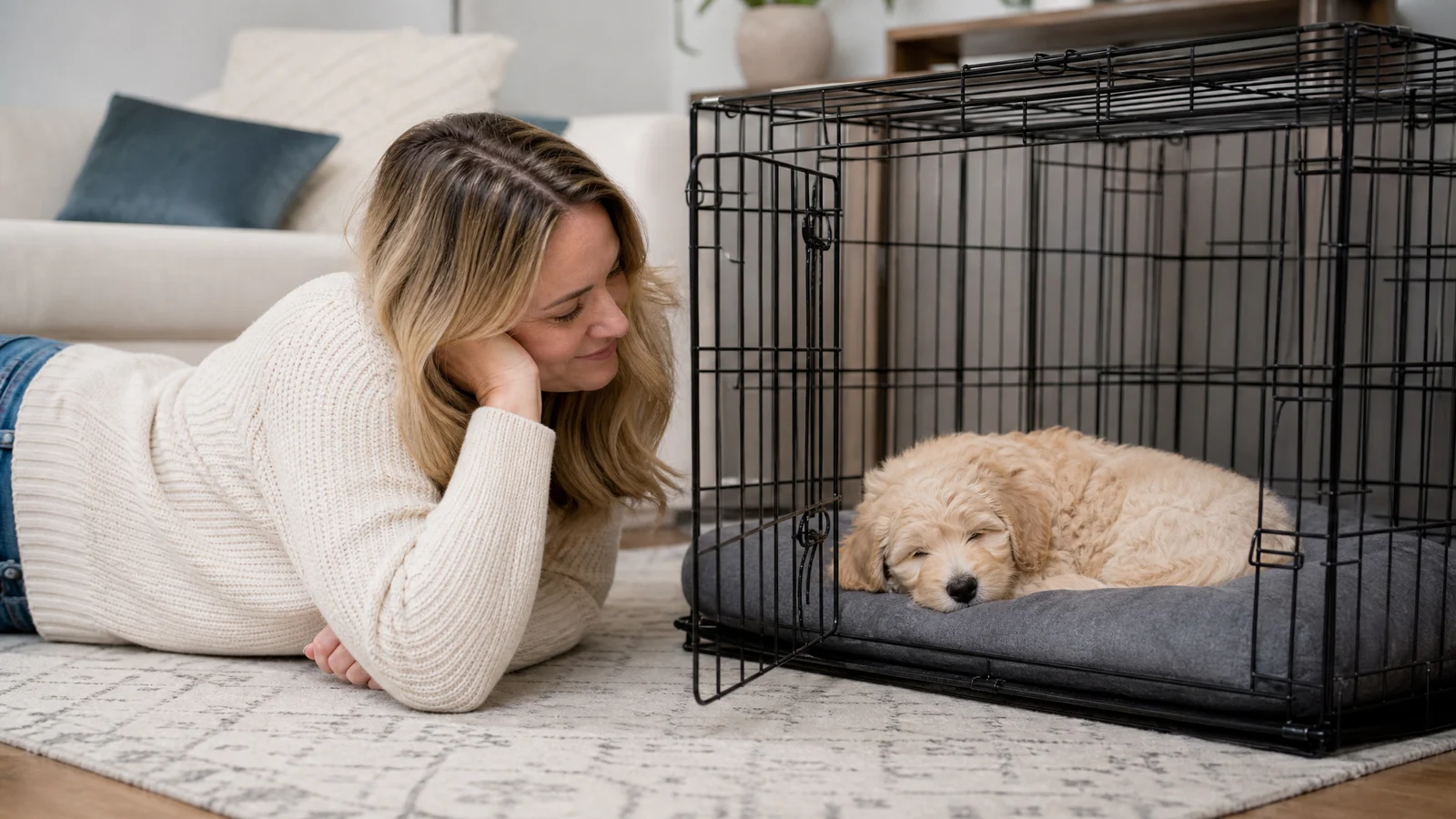
An Australian Labradoodle puppy can begin crate lessons the day your puppy comes home. The owner's real question is how soon alone time can follow. The crate comes first, brief absences come second, and the dog sets the pace, not the calendar.
Timing matters because the Labrador and the Poodle each score 5 of 5 for affection with family, and the Labrador is described as needing to be included in family activities. A cross may inherit that pull. Hurry the separations and closeness can turn into panic. Build them gradually and you get a dog who rests while you work.
Below, you'll find the choices you will meet in sequence, including when to begin, where the crate sits, whether the door shuts, which treats work best, and how to stretch a first short absence toward a full work shift.
When to Start Crate Training an Australian Labradoodle
Start the day your puppy comes home. At about eight weeks, a puppy can handle short, happy crate sessions. Early practice builds the habit before clinginess sets in, and waiting for a calmer age gives the shadowing habit more time to harden.
The pull toward people has a clear source. The AKC describes the Labrador Retriever as devoted, intelligent and enthusiastic, and says the dog needs to be included in family activities. The Poodle also scores 5 of 5 for affection with family, and the Cocker Spaniel, which sits behind some lines, earns a 4 of 5 affection score.
Any mix may inherit that need. Some puppies trail you from room to room, while others nap across the house. Plan for the stickier end. Teach rest beside the family first, then rest while the family steps away. The table maps the stages, though they overlap and your dog sets the speed.
| Stage | Goal | Move on when |
|---|---|---|
| First days home | Walk in for treats with the door open | Your dog enters with no treat in sight |
| Following days | Nap in the crate with the family in the room | They lie down and sigh without fuss |
| Next stage | Door closed briefly, then you step out of sight | They keep chewing as you move |
| Later weeks | Short real absences, then longer ones | They rest with no stress signs |
| Adolescence | Repeat earlier steps as energy surges | The old calm returns |
An older puppy, an adolescent or an adult with no crate history learns the same way. Energy runs high in both parents, with the Labrador at 5 of 5 and the Poodle at 4 of 5, so exercise your dog before each session. The choice here is to begin now, at your dog's current age, with an open door and a treat.
Crate Size and Placement Where Your Dog Can See You
Choose the crate for your dog's expected adult size, not their current size. This breed varies widely, so ask the breeder what the parents measure and check the crate maker's sizing chart. A grown dog should be able to stand, turn around and stretch out.
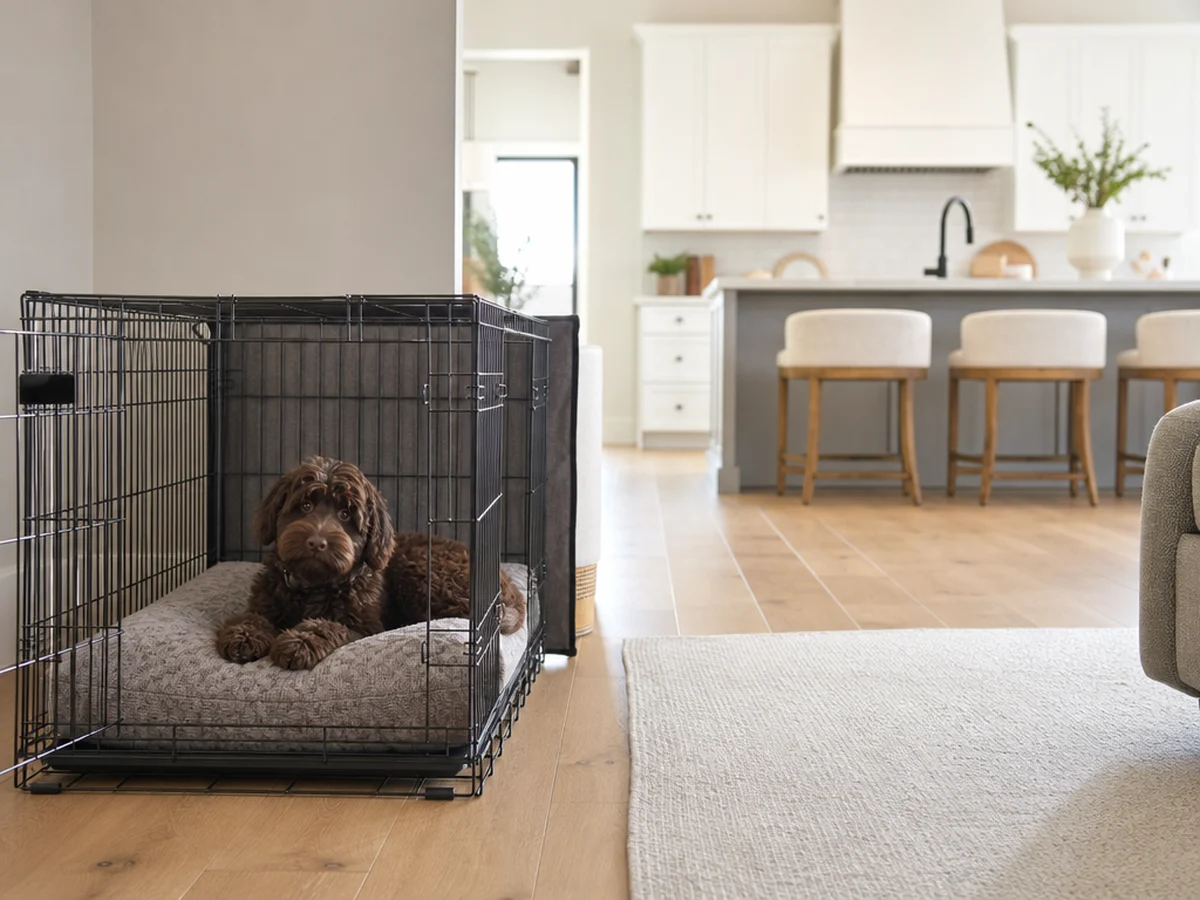
A puppy needs less room than an adult. Use a divider so they can lie down and turn around and no more. Extra space invites a corner for accidents, so pair the crate with a steady Australian Labradoodle puppy potty training schedule.
Put the crate in the room where the family lives, such as the living area or a kitchen corner. A dog built for company reads a far-off room as exile. Sight and sound of the family keep early sessions calm. At night, set the crate beside your bed for the first weeks so your puppy hears you breathe.
Move the crate later, not now. Once your dog naps easily with you in view, shift it a short distance at a time toward its long-term spot. The choice is an adult-size crate with a divider, set in the family room where you can see your dog from the sofa.
Should Crate Training Close the Door on Day One?
You have a fast route and a gradual route. The fast route shuts the door at once and waits out the protest. Common advice favors it. For this cross we disagree, because a dog who needs company learns that the crate means being cut off from everyone. We have trained this breed for many years, and that lesson is hard to undo.
The gradual route costs a few days and removes most of the protest. It also uses what the parents offer. The Poodle and the Labrador both score 5 of 5 for trainability, and Poodles are described as quick to please when sessions are fun, positive and consistent. Food or play can mark each choice you want.
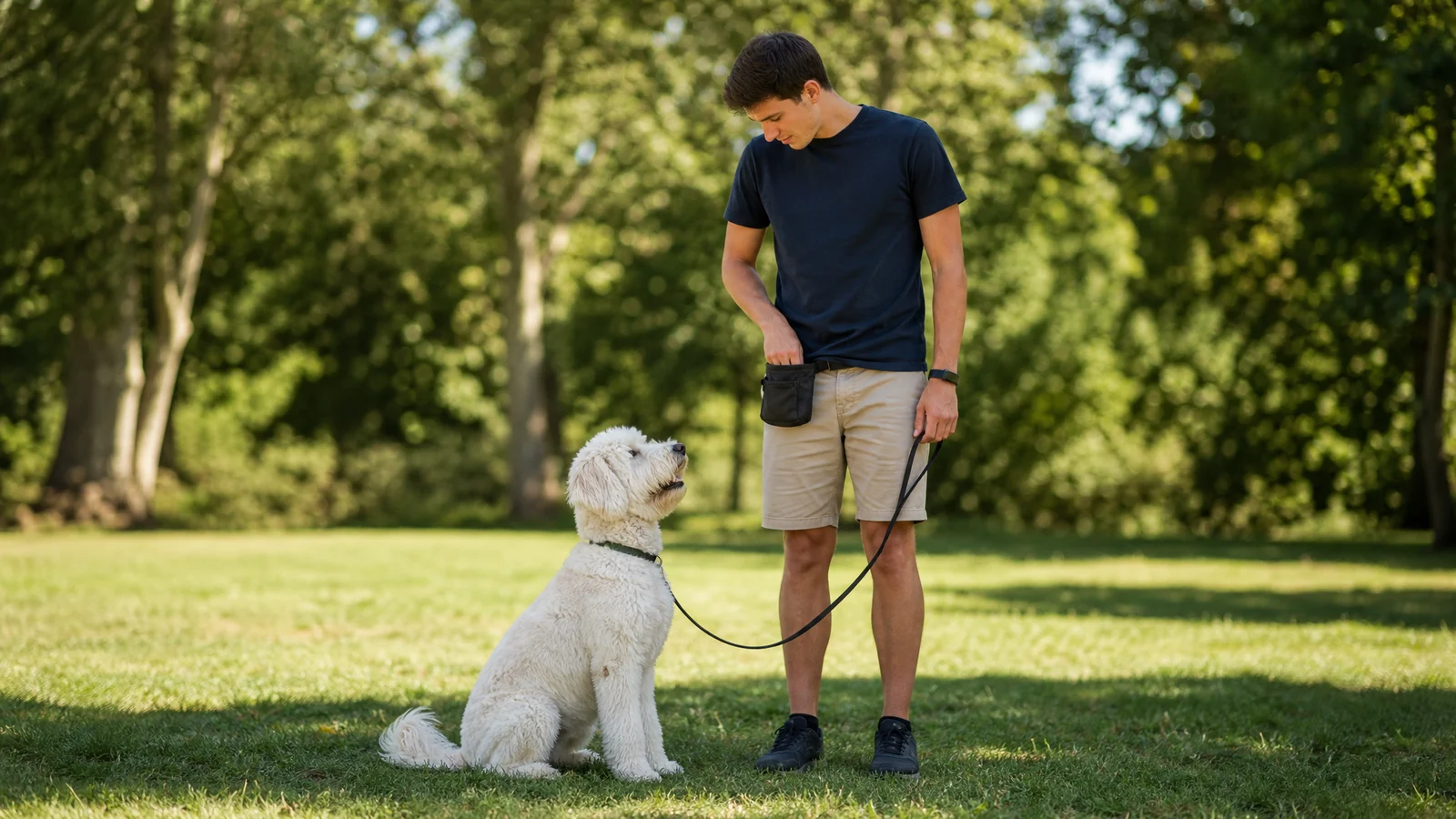
Reward-based trainers ask with a cue, mark the behavior and pay with treats, toys or other rewards. Capturing, shaping and luring all work here. Begin by teaching the marker itself: pair the marker with food by saying it and delivering a treat within 3 seconds, over several repeats in a quiet room. Then run the open-door games in this order:
- Toss a treat just inside the door and let your dog walk in and out freely.
- Mark the moment they step all the way in, and give the treat there.
- Add your cue, such as crate or bed, just as they step in.
- Shut the door briefly as you pass treats through the bars, then open it before your dog starts to fuss.
- Add a little time on each repeat while you sit beside the crate.
The choice is open-door games first, then short closed periods with you beside the crate.
Rewards That Make Crate Training Worth Choosing
A dog who follows you may like the crate only because you are near it. The goal is a crate that pays on its own, so rest there feels good even when you are across the room. Food does most of this work. Cocker Spaniels respond readily to food, play and praise, and a cross may inherit that.
Keep the best rewards exclusive to the crate. A stuffable chew that appears only inside gives your dog a reason to go in. Serve some meals there too, near the door at first and then at the back, so walking all the way in always pays. These are the rewards worth keeping on hand:
- Small soft treats for walking in and for the first door closures, since they are eaten fast enough to land right after the marker.
- Meals in the crate during the first days, which link the space with the best part of the day.
- One stuffable chew for longer closed periods, which gives the mouth a job while you move away.
- Calm praise at exits and returns, which keeps the mood low-key.
- A short play session after release, which pays for calm with fun.
The Poodle scores 5 of 5 for mental stimulation needs, so a stuffed chew that takes effort also tires the mind. Pick chews that suit your dog's size and supervise the early ones. Your veterinarian can help if you are unsure what is safe.
Keep the set small so the crate stays special. The choice is soft treats, a meal in the crate and a single stuffable chew kept for crate time only.
How Long Should the First Crate Absence Last?
Start shorter than feels useful. The first absence is only a step out of sight while your dog is crated and happy, and it should end before they notice. A few seconds is enough. Then return and reward.
Exercise comes first. With the Labrador at 5 of 5 for energy and the Poodle at 4 of 5, a dog who has run, sniffed and played settles faster. Add a potty trip and a short training game, because a few minutes of brain work tires this cross almost as well as a walk.
Watch for stress signs such as dilated pupils, panting, yawning, salivating, trembling and pacing. An exuberant greeting when you return counts too. If you see them, shorten the next absence to the length where your dog relaxes, and progress more slowly. Keep the exit routine identical every time:
- Give the chew or treat as your dog settles.
- Say the same calm word each time, without a long goodbye.
- Step out of sight with no eye contact or fuss.
- Return before the first whine, and open the door once your dog is quiet.
- Greet them calmly, since a big return teaches that your arrival is the main event.
The choice is seconds out of sight, followed by that same routine every time, so departures become dull.
Stretching Crate Training Alone Time for an Australian Labradoodle
Lengthen absences in small steps, and change either the time or the distance, never both at once. The road from the next room to a work shift is long and runs on sessions, not on a calendar. Many days will feel dull, which is the point.
Add Time in Small Steps
Move down the table only after your dog has been relaxed at the current step for several sessions in a row. Practice at different times of day, and sometimes use the crate while you stay home, so it does not always predict you leaving.
| Step | What changes | Move on when |
|---|---|---|
| Out of sight in the house | Time grows | Your dog keeps chewing as you return |
| Closed door between you | A barrier is added | They rest without pacing |
| Outside the house | Household sound drops away | They stay quiet through your keys and the door |
| Short errand | A real departure | They are settled when you return |
| Longer outing | Time grows | They rest through the whole stretch |
Backtrack When Whining Builds
Some protest is normal in a dog who has been at your heels all day. Watch whether it fades or builds. Poodles rate 4 of 5 for barking against the Labrador's 3 of 5, so a talkative dog is easy to produce, and noise alone does not mean panic.
If the whining rises, you went too fast. Drop back to the longest stretch your dog handled easily and repeat it for several sessions before trying again. Going back is part of the plan, not a failure.
Planning for a Work Shift
A work shift is the long end of this road. A young puppy cannot wait that long, so arrange a midday visit from a family member, friend or pet sitter, and build adult stretches slowly. The Labrador scores 5 of 5 for adaptability and the Poodle 4 of 5, so routine changes go well, but adapting is not the same as enjoying being left.
Keep regular vet visits on your calendar, and call your veterinarian if distress is intense, new or sudden, since behavior changes can have a medical cause. The choice is a slow pace, time added only after several calm sessions, and a backtrack the moment whining builds.
A Settled Australian Labradoodle and Your Next Crate Training Questions
Put the decisions together as one plan. Start at your dog's current age, place the crate where they can see you, keep the door open at first, pay with a small set of crate-only rewards, begin with seconds out of sight and lengthen in small steps with a backtrack rule.
All of it rests on one idea. This cross was built to be included, so forcing independence backfires and gradual, rewarded separation works. Crate comfort and short absences built in small steps suit a people-loving dog, and the dog who shadows you today can learn to rest on their own.
Questions tend to follow from here, and each one has its own article:
- Why is your dog so bouncy and eager at the door? That mix of Poodle brains and Lab enthusiasm is covered in Australian Labradoodle temperament.
- How do you keep a happy dog from pulling on walks? Start with Australian Labradoodle loose-leash walking for a dog who pulls toward every new friend.
- How do you stop accidents in the crate? The Australian Labradoodle potty training routines article covers schedules and rewards.
- What comes after the crate? Cues, manners and daily structure follow in the complete training guide for Australian Labradoodles.
 Exercise and jobsAustralian Labradoodle Energy Level: Apartment Brain Games
 Training basicsPotty Training a Fluffy Australian Labradoodle Puppy
 Training basicsAustralian Labradoodle Training: A Reward-Based Plan